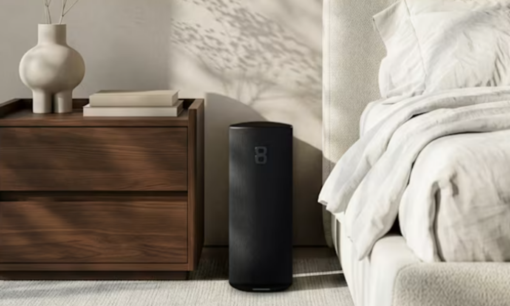
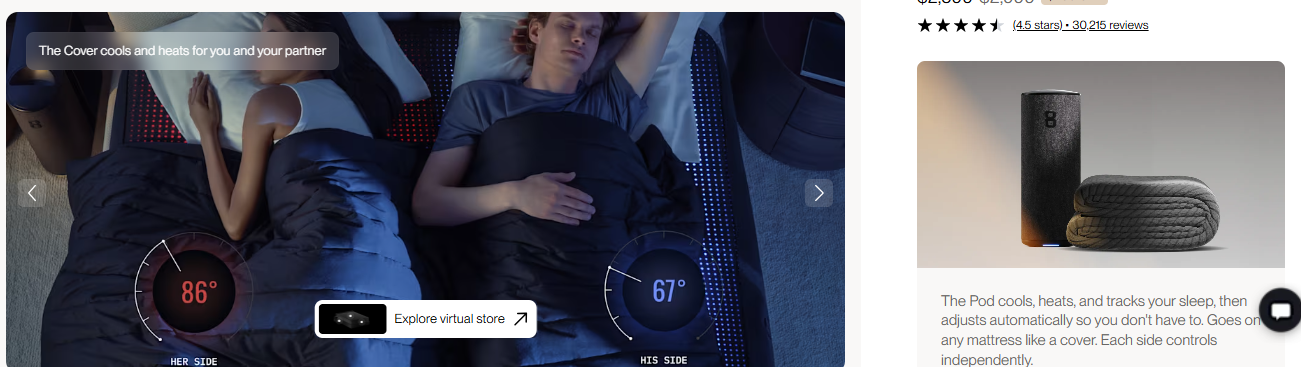
The Eight Sleep is a mattress cover + pod combo that cools and heats each side of your bed independently, tracks your sleep and recovery, automatically adjusts temperature through the night, and, in the case of the Pod 5 Ultra, can even lift your head when it detects snoring. It’s less of a mattress accessory and more a fully connected sleep system.
As you can imagine, it’s an incredibly capable bit of technology. The catch, obviously, is the price.
By the time you’ve added the Pod itself, an Autopilot plan, and maybe a few optional extras, you’re no longer making a casual bedding purchase. You’re making a long-term investment in how you sleep every night. So instead of arguing about whether Eight Sleep is “worth it,” it makes more sense to break down what the Pod actually costs over time and what that price looks like on a per-night basis.
At a Glance
| Product | Starting Price | What You’re Getting | Best For | Approx. Cost per Night Over 5 Years |
| Pod 4 | $2,649 | Previous-gen cooling/heating cover and sleep tracking | Buyers wanting the cheapest entry point | $1.45/night |
| Pod 5 Core | $2,999 | New-gen cover, tracking, thermal/vibration alarms, and Autopilot compatibility | Most people considering Eight Sleep | $1.64/night |
| Pod 5 Ultra | $4,999 | Cover, Hub, and smart Base with snore mitigation and elevation | Couples, snorers, recovery-focused sleepers | $2.73/night |
| Autopilot Standard | $199/year | Smart temperature adjustments and sleep reports | Essential functionality | $0.55/night |
| Autopilot Enhanced | $299/year | Adds an extended 5-year warranty | Long-term owners | $0.82/night |
| Autopilot Elite | $399/year | Adds advanced health monitoring | Data-heavy wellness users | $1.09/night |
Pod 4 vs. Pod 5 Core vs. Pod 5 Ultra
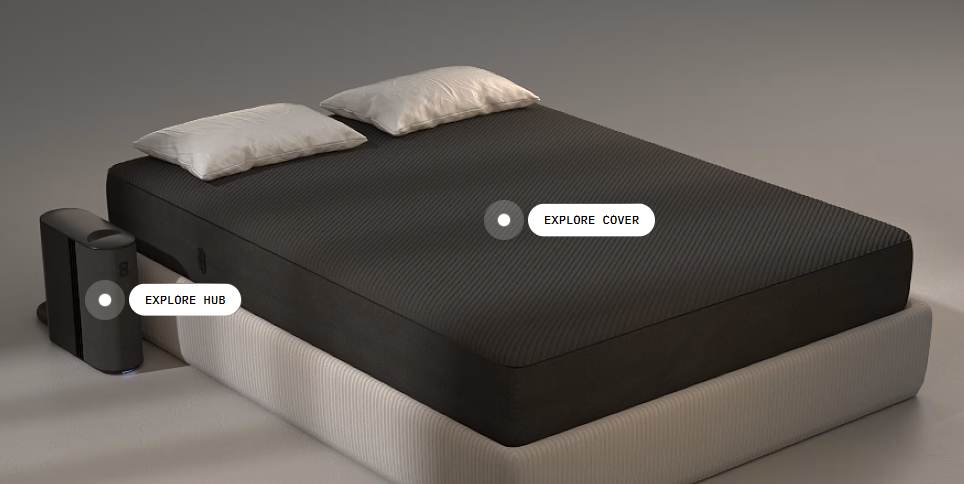
The jump from the Pod 4 to the Pod 5 Ultra can feel like a bit of a sticker shock. What’s important to keep in mind is that you’re gradually moving from a temperature-controlled sleep setup into something much closer to a fully connected smart bed.
Pod 4: The Most Practical Entry Point
The Pod 4 starts at $2,649 and is essentially the older-generation version of the system. You still get the core experience that people buy Eight Sleep for in the first place: dual-zone cooling and heating, sleep tracking, and thermal or vibration alarms that wake you up more gently than a phone screaming on your nightstand.
This version makes the most sense if your main issue is straightforward overheating. If you’re someone who wakes up sweaty at 3 a.m., flipping your pillow over repeatedly and sticking one leg out from under the blankets in desperation, Pod 4 solves that problem well.
What you’re missing is all of the tracking that comes with it. Of course, there’s something kind of appealing about the simplicity of it. Not everyone wants a bed that tracks everything imaginable; some people just want to stop waking up hot and sleep through the night consistently.
Pod 5 Core: The One Most People Will Want
The Pod 5 Core at $2,999 is where the automatic temperature adjustments, sleep tracking, vibration alarms, and side controls all start working together in a way that feels particularly thoughtful. You get full-body tracking thanks to its biometric sensors, and the system uses this data to continually adjust the temperature throughout the night rather than forcing you to manually fiddle with settings every evening.
The dual-zone temperature control is one of the best and most essential features here. If one person wants the room freezing cold while the other is secretly turning into an icicle under three blankets, Eight Sleep removes that entire dynamic.
Pod 5 Ultra: Where Eight Sleep Turns into a Full Smart Bed
Then there’s the Pod 5 Ultra, which starts at $4,999. With the addition of conveniences like a smart Base underneath the mattress, the system is no longer just about cooling and heating. The bed can elevate for pressure relief, automatically respond to snoring, play soundscapes, and shift positioning throughout the night.
Some of these features may sound a bit excessive until you think about the people they’re designed for. The snore mitigation feature is a good example. Instead of the traditional midnight elbow to the ribs, the Base gently elevates the sleeper when snoring is detected. On paper, “my bed lifts my head when I snore” sounds like a bit of a gimmick, but it solves a major problem that would otherwise ruin a couple’s night.
The Subscription: Required but Inherently Essential
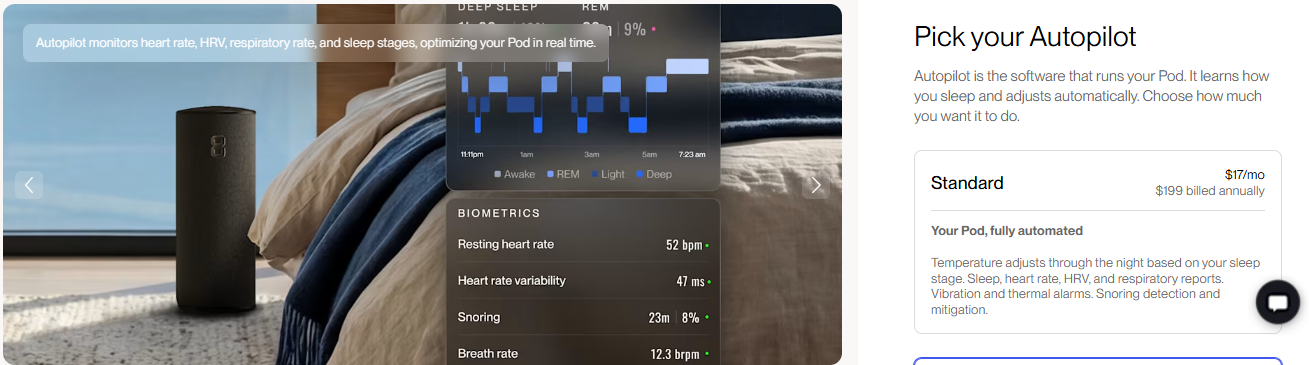
Eight Sleep requires an Autopilot plan for at least the first year of ownership, with three tiers ranging from $199 to $399 annually, depending on the features and warranty coverage you want.
This is where things get a bit contentious. After all, if you spend several thousand dollars on a product, there’s a psychological expectation that you should fully own it afterward. Subscription fatigue is a real thing, but in Eight Sleep’s case, the ongoing intelligence is half of the value here.
A huge part of what makes Eight Sleep feel different from standard cooling products is the software layer itself. The system is constantly learning your sleep patterns, adjusting temperatures automatically, tracking trends, and refining how it responds throughout the night. As a result, the subscription feels less like paying to unlock basic functionality and more like ongoing software support for a connected sleep platform.
Whether that distinction feels reasonable depends on how much value you place on the automation itself versus simply having a cooled bed.
What the Price Looks Like over Time
Seeing a $3,000 or $5,000 purchase attached to your bed, which may already be outfitted with an expensive mattress, can feel overwhelming at first. However, like with many other big purchases (especially health-related ones), the price is a bit more palatable when you stop thinking about it as one huge purchase and start looking at how often you’ll actually use it.
Take the Pod 5 Core with the Standard Autopilot plan. Over five years, you’re looking at roughly $2.19 per night all-in. That still isn’t cheap, but it’s also not wildly out of step with the way people spend money on everyday comfort anymore, from random forgotten subscriptions to tiny inconveniences that we’ve grown accustomed to.
The difference is that sleep purchases feel emotionally bigger because they’re attached to one large upfront number instead of dozens of smaller invisible ones.
The Ultra shifts into a different category entirely, of course. Once you pair the Pod 5 Ultra with one of the higher Autopilot tiers, you’re comfortably into luxury wellness territory at over $3.50 per night long-term.
However, I don’t think Eight Sleep is really competing with ordinary bedding at that point anyway. It’s competing with high-end adjustable smart beds, recovery technology, wellness optimization products, and the growing number of people willing to spend serious money to improve their sleep quality.
That context matters because the Ultra makes far more sense once you stop evaluating it like a blanket accessory and start evaluating it like a fully integrated sleep environment.
The Add-Ons: Luxury Purchases or Value Adds?

At first, things like a temperature-controlled blanket or cooling pillow cover sound a little over-the-top. Then, you remember how many tiny sleep annoyances people quietly tolerate every single night without thinking much about them.
The Blanket extends the cooling and heating across your whole body instead of concentrating it mostly underneath you. The Pillow Cover focuses specifically on keeping your head and neck cool through the night — this is probably the easiest one to underestimate. Almost everyone has done the middle-of-the-night pillow flip searching for the cold side; it’s one of those small routines that feels normal even though it quietly breaks up your sleep.
That’s kind of the recurring theme with Eight Sleep in general. A lot of the features sound unnecessarily luxurious at first, but they’re usually built around solving very ordinary nightly frustrations people have just learned to live with
Eight Sleep: Weighing the Benefits Against Long-Term Comfort
There’s no version of this where Eight Sleep becomes a cheap purchase. Even the entry-level setup costs more than most people have ever spent on sleep products before. But I also think that’s why the cost-pbioer-night framing matters so much here. Once you spread the cost across years of nightly use instead of one painful checkout screen, it starts feeling a little less outrageous.
And for a lot of people, it’s a cost they’re happy to pay. They stop obsessing over the technology after a while and start talking about smaller things instead: sleeping through the night, not overheating anymore, and waking up less exhausted.
That’s ultimately the real calculation you should be making.