
If you’re like me, you may have woken up the last several weeks in a row to a pretty disappointing WHOOP score. Now, you’re looking for ways to boost that score and subsequently boost both your sleep and recovery.
I always feel as though a heavy workout or a pretty physically taxing day training, hiking, or otherwise being outdoors should automatically give me a good score because I’ll automatically fall into a deep sleep but sometimes that just isn’t the case.
I had to learn that optimizing my WHOOP recovery score required a shift in my perspective away from thinking about how rested I felt when I woke up and more on what data actually drove my algorithm. It’s the same data that drives everyone’s algorithm.
WHOOP is a performance-first system and it calculates recovery by measuring your nervous system’s ability to handle strain so it’s very different from general wellness trackers that are just going to look at how many hours you slept.
Top Ways to Improve

With that in mind, I’m going to go over:
- How to keep your thermal regulation well regulated
- Why you need to control your sleep environment
- The importance of stress management
- How to master your strain-recovery loop
- How to use nutrition and hydration strategically
- And how to stay consistent
But first let’s take a step back.
The WHOOP Recovery Equation
Let me give a quick brief on how the WHOOP recovery equation actually works so you understand why those top ways to improve your score will actually make a difference.
WHOOP’s recovery score is driven primarily by overnight physiological signals, especially HRV, resting heart rate, respiratory rate, and sleep performance.
- Heart Rate Variability (HRV): The primary driver of your score is your HRV. To be fair to WHOOP, it’s a primary driver of just about every score. It measures the balance between your sympathetic (fight or flight) and parasympathetic (rest and digest) nervous systems. So if you do things like wake up a lot because you’re too hot, eat right before bed, or go to sleep at different times throughout the week, it can have a negative impact on your HRV and subsequently WHOOP score.
- Resting Heart Rate (RHR): Your RHR is a proxy for cardiovascular health and stress levels. A lower RHR typically correlates with higher recovery. That’s something WHOOP looks at.
- Sleep Performance: WHOOP actually calculates the ratio of the sleep you achieved versus the “Sleep Need” so all of this takes into consideration recent strain and sleep debt. That’s why it’s important to avoid overtraining and to stay consistent with your sleep.
- Respiratory Rate: Stable breathing is a sign of health, so it makes sense that when there is a spike in your breathing, it could be an indicator of overtraining or illness. And that’s exactly what WHOOP thinks so significant spikes and respiratory rate while you sleep can bring your score down.
So if you want to improve WHOOP score you have to improve the things that impact sleep performance, respiratory rate, RHR or HRV. Let’s dive in.
Top 6 Ways to Improve Your WHOOP Score
There are several ways that you can improve your WHOOP score but these are my top six picks.
1. Precision Thermal Regulation
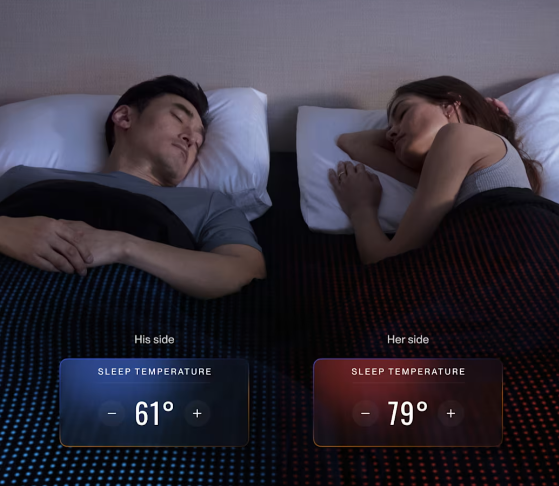
One of the biggest disruptions to your sleep and your sleep score is temperature fluctuation. Changes in overnight physiological signals, including elevated skin temperature trends, can correlate with lower recovery scores.
As an athlete one of the things you’re going to struggle with the most during your recovery is temperature fluctuation, especially the spikes that come after a workout and during repair. These tend to result in sleeping hot so if you don’t have some form of active temperature regulation system in your room and your bed, every time your temperature spikes it’s going to drag your WHOOP score down and you’re going to end up waking up which disrupts your recovery.
Something like the Eight Sleep Pod can be a crucial performance partner with an autopilot function that actively pulls heat away from your body to keep your core temperature down. This regularly monitors your temperature throughout the night and it can help increase your HRV and your deep sleep duration.
You want to keep your entire environment cool when and where you can and that means things like running an air conditioner, having breathable bedding, and using active resources like the Pod to help keep your RHR low throughout the night, directly feeding a higher recovery score the next morning.
Tip: Keep your space and your bed cool with active cooling systems.
2. Control Your Sleep Environment

Your WHOOP score is indirectly impacted by your sleep environment. As mentioned, you want to keep your entire sleeping environment cool, and that means things like good, breathable fabrics for your bedding, maybe a separate fan.
But you also want to keep that sleep environment pristine not in the sense that it shouldn’t be messy although it probably shouldn’t be but more in the sense that it is a sacred place where sleep is one of the only two activities that happens.
This will ensure that your brain associates the area with sleep and not much else. Doing so ensures that your brain knows to start winding down when it gets to that space.
I would recommend things like blocking out light when and where you can, including blackout curtains and no lights, doing away with noise as best you can, maybe with a white noise machine or the Eight Sleep Pod’s audio functions that give you sleep-inducing sounds as you go to bed.
Basically do what you can to keep your space focused exclusively on sleep with minimal disruptions or distractions.
Tip: Keep your sleep environment sacred.
3. Manage Your Stress

Stress can negatively impact your sleep score and recovery. So, if you want to boost your WHOOP score you have to find ways to minimize stress so that you minimize things like heart rate spikes, respiratory spikes, or middle of the night wake ups.
I find that I fall asleep very easily, and deeply…for about 30 minutes.
Then I’m suddenly awake with a list of unfinished tasks running through my brain. Sometimes it’s more creative things, something that I let my subconscious chew on throughout the day and it spits out at the most inconvenient time.
So, I keep a notepad next to my bed so that I can write everything down and then fall back asleep without further disruptions, otherwise it’s going to keep spinning in my mind and keep disrupting my sleep. So find something that works for you based on your source of stress.
Tip: Do some sort of stress reduction technique before you go to bed, something like gentle yoga or stretching, a massage chair if you have one or even a massage gun if you have that, mindful meditation, or journaling.
4. Master the Strain-Recovery Loop

Your recovery is largely a reaction to yesterday’s strain. And your WHOOP score knows that. So you want to avoid overreaching or overtraining. If you have WHOOP, use it; check your WHOOP Strain Coach before training. You can stay in the green if you avoid pushing into that overreaching zone especially if your recovery is already yellow. If you push too much you’re going to end up in the red tomorrow.
You have to be aware of that strain-recovery loop and stay within the confines of Zone 2 for active recovery. This means using low intensity sessions to support circulation and recovery.
Tip: Don’t over reach. Keep your fitness within limits.
5. Strategic Hydration and Nutrition

Your WHOOP score, as I mentioned, takes into account a lot of things like your resting heart rate and heart rate variability.
Both of these can be negatively impacted by things like heavy meals right before bed and dehydration.
If you eat too close to bedtime, then what happens while you sleep is your body focuses on digestion instead of the physiological repairs that it should be doing. This causes spikes in things like body temperature and heart rate leaving you with a bad score the next morning and even worse, bad muscle repair.
So, you should always aim to eat your last meal at least 3 hours before you go to bed so that your resting heart rate can drop a lot earlier in the night allowing for deeper sleep to come much sooner.
Similarly, dehydration will lower your HRV and spike RHR. This is one area I personally struggle with, since I often realize I’m dehydrated at the end of the day. So, after my last meal, I drink 20 oz of fluid all at once which disrupts my sleep for obvious reasons.
So, do as I say not as I do and prioritize hydration earlier in the day so that you don’t disrupt your sleep with a lot of bathroom runs at night and you can keep your RHR and HRV where they should be.
Tip: Be mindful of when you eat and drink. Keep hydrated, but not at the end of the night.
6. Radical Consistency

WHOOP rewards a stable circadian rhythm. But a big part of that consistent circadian rhythm is when you go to bed and when you wake up.
Two weeks ago I was out with friends on what turned out to be a 20 mile bike ride. Then we relaxed by walking around town and I came home and did yoga before bed. I was wiped. I also knew I didn’t have to get up for anything pressing the next morning so I turned off my alarm.
I woke up around the same time I normally do but I was groggy and honestly I was just feeling lazy. So instead of getting up and starting my day, I just rolled back over and went to bed. I ended up sleeping for another three hours.
It felt so good at the moment but I definitely paid for it later not just because I couldn’t fall asleep that night, when I actually did have a reason to get up the next morning, but because of my WHOOP score.
I say all this because sleep consistency is the only way to keep that stable circadian rhythm.
This means you have to go to bed and wake up within the same 30 minute window every night no matter how hard you worked that day or what obligations you have in the morning.
Doing so ensures that your body enters into its restorative stages of sleep seamlessly and regularly. Otherwise your score will detect a lot of variability and changes which it reads as unhealthy sleep patterns.
Tip: Stay consistent. Going to bed and waking up within the same 30-minute window helps your body enter restorative stages of sleep more efficiently, maximizing the “Sleep Performance” portion of your score.
Round Up
There are several things that you can do to improve your WHOOP recovery score as long as you understand how that recovery equation works. With a consistent schedule where you go to bed and wake up at the same time, strategic nutrition times and hydration, and good thermal regulation, you can make sure that things like your heart rate variability and respiratory rate give you a good score every morning.