
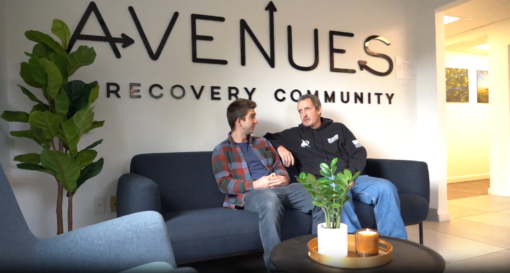
If you’re looking for the best rehab in New Hampshire, you’re going to have a difficult time finding it. That’s not because there aren’t quality facilities in the state; it’s because it’s not really possible to choose an objectively “best” rehab. The facility that works for one person can be a poor fit for the next, even when both people are dealing with the same issue.
What does exist is many different options that could be a good fit for a wide range of people. In a smaller state like New Hampshire, the comparison of treatment facilities might feel a little different just because it will likely have more limited options compared to a larger state. There may be fewer facilities within easy driving distance, and the ones that exist vary in what they actually provide.
Some offer medical detox and 24/7 residential treatment. Others focus entirely on PHP, IOP, and outpatient care. Some combine outpatient treatment with recovery housing rather than operating a traditional residential campus.
This makes it especially important to figure out what level of care someone actually needs before comparing facilities at all. From there, the decision usually comes down to a handful of personal factors and priorities.
One thing worth mentioning before we get to specific facilities: a program should not be judged negatively simply because it doesn’t operate a traditional inpatient program. An outpatient-focused provider isn’t a lesser version of a residential one; it’s just serving a different clinical need.
Avenues Recovery
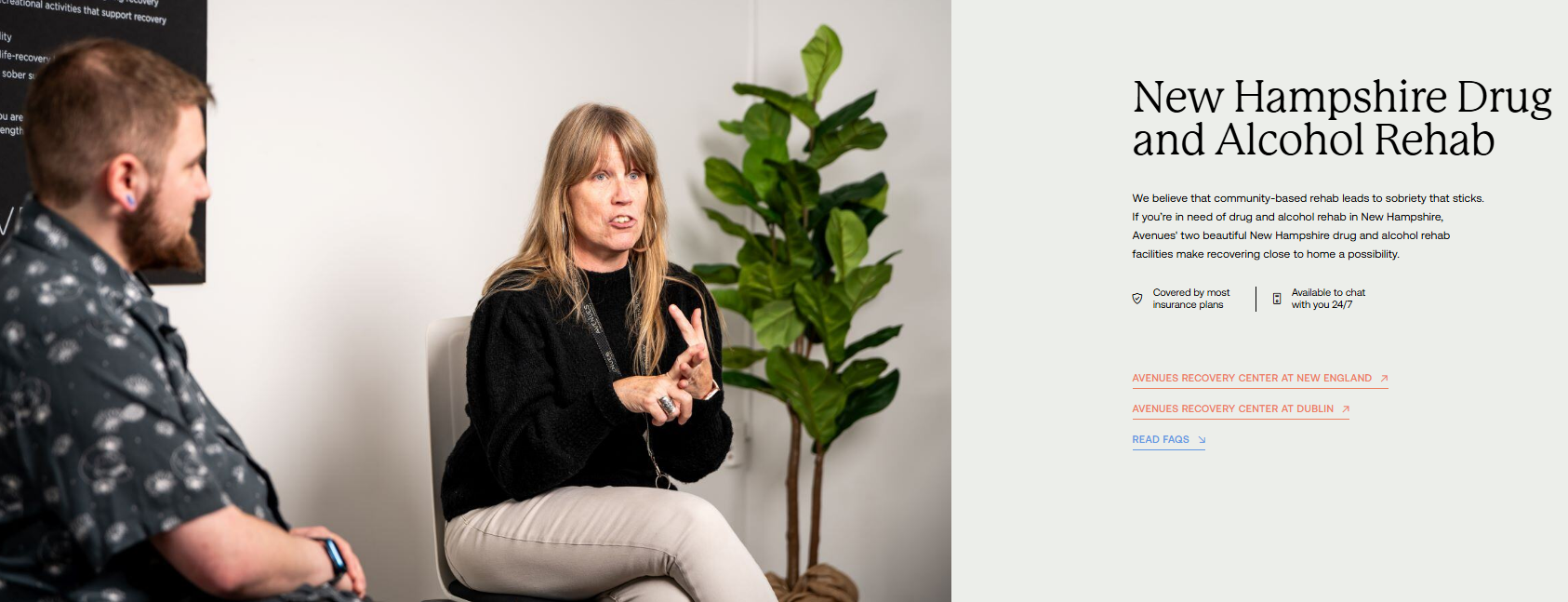
New Hampshire locations: Dublin and Concord
Avenues Recovery has two facilities in New Hampshire. Dublin is the more traditional residential and inpatient campus, while the Concord location uses a treatment-and-recovery-house model. Together, the two locations allow Avenues to serve people who need very different levels of structure.
Both New Hampshire facilities are Joint Commission-accredited, which means the programs have been evaluated against external standards for safety and quality of care.
The alumni offerings of both facilities are also worth noting. Most people compare facilities based on what happens during treatment, but the period right after discharge is when recovery is most fragile; the structure disappears, the daily contact with clinicians ends, and people return to the environments they left.
An organization with an active alumni community can make that transition easier because the connections built during treatment can continue. Avenues advertises a strong alumni community, which fits its broader emphasis on recovering close to home and staying connected to the people who went through it with you.
Dublin – Residential Treatment in a Secluded Setting
Dublin is the residential campus. It offers withdrawal management with 24/7 medical care, residential treatment, PHP, IOP, standard outpatient care, dual-diagnosis treatment, and a military and veterans program. Within these programs, they offer family and couples counseling and medication-assisted treatment. Clinical approaches are listed as including CBT, DBT, and motivational interviewing.
They also offer workforce re-entry support, 12-step programming, and holistic arts programming. The clinical team is specifically described as including a full-time physician, a psychiatrist, and licensed counselors.
For the inpatient level, clients live and receive treatment within the same building, which includes light-filled bedrooms with en-suite bathrooms, rustic lounges, an onsite kitchen and cafeteria, classrooms, group rooms, onsite laundry, and gym access, with meals and local transportation provided. The campus is described as secluded and rural rather than urban or hospital-like.
Regarding insurance, Avenues lists Dublin as accepting most insurance and identifies several in-network plans, including Medicaid.
Best fit for: Someone who needs medical withdrawal management or 24/7 care; someone who wants treatment, meals, and living accommodations in one facility; people with co-occurring mental health needs; residents of southwestern New Hampshire; and anyone who prefers a more secluded setting.
Avenues Recovery – New England (Concord)
Avenues describes the New England program as an extended-care treatment center that partners with recovery housing, allowing clients to attend treatment at the Concord clinical facility while living in a structured, home-like environment.
They also partner with step-down sober living apartments for clients who could benefit from additional support and structure after treatment ends.
This is a long-term treatment option, with the length of stay based on individual clinical need.
The program serves communities around Concord, Pembroke, Hooksett, Hopkinton, Loudon, Goffstown, Henniker, Pittsfield, and the surrounding central New Hampshire area. Family involvement and continuing support are important parts of both programs and include family therapy, visitation after an initial adjustment period with clinical approval, alumni support, and longer-term community involvement after formal treatment ends.
Best fit for: Someone medically stable enough for an extended-care model; people who need structured recovery housing while attending treatment; residents of central New Hampshire; and those who want longer-term support without remaining in a traditional residential facility throughout treatment.
Granite Recovery Centers
New Hampshire locations: Effingham, the Derry/Londonderry area, Canterbury, and Salem
Granite Recovery Centers operates four New Hampshire facilities, and the network is best described as one system with four distinct roles rather than four versions of the same rehab.
Green Mountain Treatment Center — Effingham
Green Mountain is Granite’s flagship dual-diagnosis residential addiction treatment center, set on more than 70 acres in the White Mountains. It provides onsite drug and alcohol detox, residential treatment, PHP, IOP, dual-diagnosis treatment, medication-assisted treatment, sober living connections, telehealth, family therapy, and individual counseling, drawing on CBT and DBT.
What Granite specifically advertises is 24/7 monitoring by licensed nurses, medical director oversight, medical and psychiatric APRNs, and individualized treatment planning, alongside both SMART Recovery and 12-step programming.
This facility also offers LGBTQ+ affirming support, veteran services, and outdoor programming, including nature hikes and sports. Family involvement includes individual and couples therapy and a weekly family support group that remains available to family members even after their loved one becomes an alum.
Best fit for: Someone who needs detox or residential treatment, wants a rural campus, needs dual-diagnosis care, or wants multiple recovery pathways rather than one single model.
The Granite House — Derry/Londonderry Area
The Granite House is a residential treatment center that specifically serves adults covered by New Hampshire Medicaid; Granite markets it as its Medicaid residential option. That makes it one of the more relevant options to look into for someone who needs Medicaid to access treatment.
Services include residential treatment, access to medical detox, dual-diagnosis treatment, 24/7 clinical support, medication-assisted treatment, CBT, DBT, individual counseling, family therapy, trauma-informed care, and both SMART Recovery and 12-step groups.
Best fit for: Someone who needs residential care and relies on New Hampshire Medicaid.
Canterbury Behavioral Health — Canterbury
Granite describes the Canterbury location as a 20-bed residential facility on 17 private wooded acres for adults 18 and over dealing with severe mental health conditions, including schizophrenia, schizoaffective disorder, and bipolar disorder, as well as co-occurring severe mental health and substance use disorders.
Services include residential treatment, PHP, IOP, dual-diagnosis care, telehealth, CBT, DBT, family therapy, individual counseling, medication-assisted treatment, veteran services, young-adult programming, and SMART Recovery and 12-step groups.
Best fit for: Someone whose treatment needs involve serious mental health concerns alongside or instead of a primary substance use diagnosis.
New Freedom Academy — Salem
New Freedom Academy provides the outpatient side of Granite’s New Hampshire network, offering PHP, IOP, dual-diagnosis treatment, telehealth, sober-living referrals, and mental health programming.
The PHP runs as full-day treatment six days per week and includes breakfast, group therapy, and lunch, with clients stepping down into more flexible outpatient treatment from there. Clients receive weekly individual sessions with master’s-level clinicians, group therapy, family therapy and check-ins, and alumni support.
Best fit for: Someone medically stable enough for outpatient treatment, including people stepping down after residential care and southern New Hampshire residents who need structured treatment without living onsite.
Discover Health Group
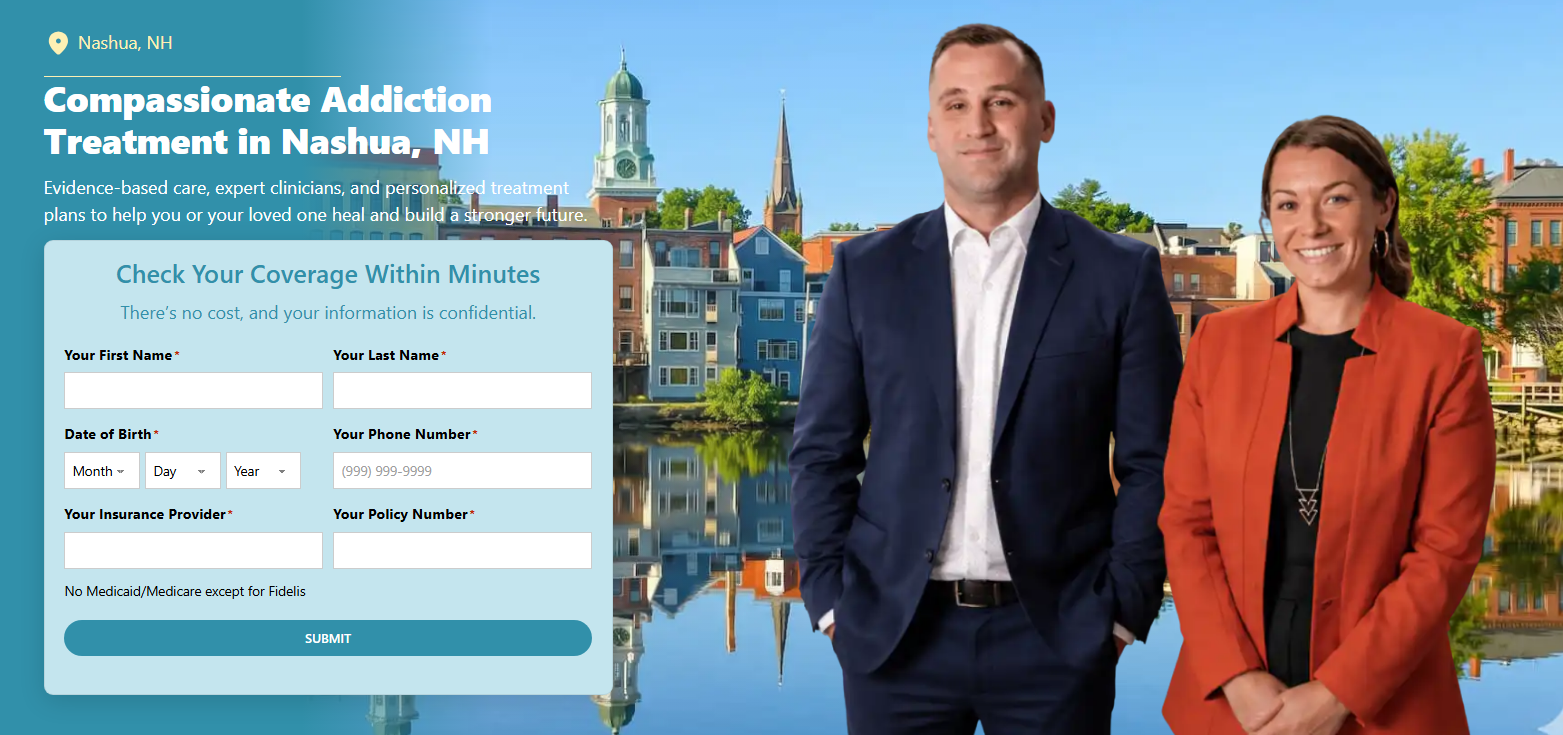
Location: Nashua
Discover Health Group is an outpatient treatment provider. Its programming includes PHP, IOP, standard outpatient treatment, medication-assisted treatment, mental health and dual-diagnosis treatment, and a program designed specifically around working professionals, with in-person, virtual, and hybrid options. PHP runs Monday through Friday from 9 a.m. to 3 p.m.
The Evening Professional Track operates Monday through Thursday from 6 p.m. to 9 p.m., specifically creating an option for people who cannot attend treatment during traditional working hours. Clients receive weekly individual therapy regardless of program level, and an onsite nurse practitioner can provide psychiatric evaluation and medication management.
Treatment modalities include CBT, DBT, ACT, and cognitive processing therapy where appropriate, covering conditions such as depression, anxiety, PTSD, bipolar disorder, OCD, and panic disorders alongside substance use.
Family support includes both individual family therapy and monthly virtual family education and support programming.
Their website says they do not accept Medicaid.
Best fit for: People who don’t need 24/7 residential treatment; someone who needs PHP or IOP; people who want to continue working through treatment; southern New Hampshire residents; and people with co-occurring mental health needs.
The Process Recovery Center

Location: Nashua
The Process Recovery Center is another Nashua option, though it operates somewhat differently from some of the others. They seem to offer medically supervised detox, but do not operate a residential treatment center. Detox at The Process includes 24/7 medical monitoring, with the clinical team managing withdrawal symptoms, stabilizing clients, and preparing them for the next level of care, either the facility’s own outpatient program or residential treatment elsewhere.
Programming includes PHP, IOP, outpatient services, medication-assisted treatment, dual-diagnosis treatment, aftercare planning, and connections to sober living.
The Process Recovery Center combines clinical treatment with access to sober living. Its PHP allows clients to attend full-day treatment while returning home or to sober living at night, and the organization also provides sober living coordination as part of its broader continuum of care.
The facility’s FAQ says it is Joint Commission accredited, with master’s-level clinicians, a psychiatric mental health nurse practitioner, and a registered nurse. The Process says it accepts most major insurance and New Hampshire Medicaid, with cash-pay and payment-plan options also available.
Best fit for: People medically stable enough for outpatient care; someone stepping down after residential treatment; New Hampshire Medicaid beneficiaries; people who need sober housing combined with outpatient clinical care; and southern New Hampshire residents who need treatment that works around daily responsibilities.
How Insurance Can Narrow Your New Hampshire Options

When searching for addiction treatment in New Hampshire, the reality is that your insurance will play a major role in shaping your options. Many facilities take major insurance plans and Medicaid, but that doesn’t mean they’re in-network or that they accept your specific plan. Sober living or recovery housing adds another thing to consider, as these may not be covered by insurance at all.
Before you get too attached to choosing a facility, double-check exactly which plans are accepted, that your specific level of care is included, and if you have any out-of-network benefits if applicable. Always verify your benefits with both your insurer and the treatment center before you get emotionally invested.
Staying Close to Home or Traveling for Treatment

In a state the size of New Hampshire, this question comes up more often than it would elsewhere. If you live in Nashua and the program that fits is in Effingham, that’s a bit of a drive; one you’re almost certainly not going to make for outpatient treatment. That means if you go to inpatient treatment far away from your house, you’ll likely need to find another outpatient provider (or recovery housing nearby) when you are ready to step down.
There’s sometimes an assumption that going far away is better, with the argument that distance from familiar people, places, and triggers is helpful. Sometimes that’s true. If someone’s daily environment is genuinely making things more difficult, it’s worth considering a treatment facility that is farther away. Traveling can also open up access to a specific level of care or specialty program that isn’t available nearby.
But getting treatment nearby often has many benefits as well. Family involvement is easier when family can actually attend sessions and visit. Alumni communities and peer connections built during treatment stay more relevant and useful afterward if they’re local. Recovery ultimately has to work in the environment where the person lives, so learning to manage it there is valuable as well.
As with most things related to choosing the right treatment center, there’s no right or wrong answer about whether to travel. It’s about whatever makes the most sense for you and your family.
What I Wish I’d Known About Alumni Support

When I went to treatment myself, I didn’t realize how important the alumni piece could be. I went to a facility that was a five-hour plane ride from home, and they didn’t have any locations or alumni community near where I lived. They offered Zoom meetings and some meet-ups, but I still felt like I was missing that local connection.
Looking back, I think I would have had more support from people who really understood what I was going through if I had gone to treatment closer to home, or if the facility I chose had a stronger alumni presence in my area. I maintained my sobriety after treatment, so this wasn’t necessarily a make-or-break factor, but it was hard to be home after spending so much time away and to feel like I was kind of alone with everything.
How to Evaluate a Facility Past the Marketing Copy

Treatment websites are remarkably similar to each other. Individualized care, compassionate staff, evidence-based treatment, a peaceful setting – after reading a few, they all start to sound the same. Here’s what to look at instead.
Look For Specifics
A facility that tells you its clinical team includes a full-time physician and psychiatrist is giving you something verifiable. “Experienced, caring staff” isn’t. The same goes for program details; “a minimum of four individual sessions per week” tells you more than “personalized attention.”
Check Accreditation and Licensing
Joint Commission accreditation or CARF certification indicates a facility has been reviewed against external standards.
Asking What Happens After Treatment
Asking a facility what happens once treatment ends is one of the most revealing questions you can ask. A facility with an actual answer, like an outpatient program or a strong alumni community, has thought through this concern. When a provider simply tells you they’ll figure it out when the time comes, that can be problematic.
Weigh Reviews Carefully
Online reviews in this space skew toward extremes, and people write them at emotional moments. Patterns across many reviews carry more significance than a bad review here and there. Look at reviews on external websites, like Google and Yelp, because many facilities tend to curate the reviews on their websites, meaning only the positive ones are shown.
Taking The Next Step

If you’re trying to find the “best” rehab in New Hampshire, don’t get hung up on that word. There’s no such thing as the best rehab, as everyone dealing with addiction may need something a little bit different. It doesn’t matter whether the right program is on a mountainside or right down the road. What matters is that it provides the level of care you need, works for your situation, and gives you a realistic path forward.
When I was dealing with this for myself, I spent way too much time researching and considering facilities that weren’t even options. I didn’t realize how quickly the insurance and payment piece would narrow my list down, so I always suggest you figure that out first before spending too much time considering facilities. The process is frustrating and can feel like it’s taking far too long, but you’re on the right track, and help is there for you. As long as you’re moving forward and reaching out for the help you need, that’s what matters.
Related Posts:







Rachael Goldstein is a licensed attorney who spent six years as a public defender in Philadelphia, handling a wide range of cases. That work gave her a close, firsthand look at how addiction and mental health affect people’s lives, and it’s shaped her writing ever since. Her writing focuses on mental health and wellbeing, drawing on both her legal background and hands-on experience in the field. She knows how high the stakes are when someone is searching for help, so she digs into the research and lays out the facts in a way that’s clear, honest, and easy to act on.
When she’s not writing, Rachael spends her free time traveling, hiking, and exploring new places.