

If a healthcare professional has recommended gammaCore, you might assume the next step is simply to order one, but gammaCore is a prescription medical device, and access starts with a clinician completing a form before payment and shipping can be arranged.
That can be frustrating. You’ve already had the conversation, looked into how the device works, and decided it might be worth pursuing. Then you discover that access itself is the problem.
So what can you actually buy instead?
Nuropod, Truvaga, and Pulsetto are the main gammaCore alternatives sold directly to consumers. All three use electrical stimulation, although Nuropod targets the ear while Truvaga and Pulsetto stimulate at the neck. Apollo Neuro often appears in the same comparisons, but it uses vibration rather than electrical stimulation.
The word “alternative” needs some care here. It’s important to note that not one of these devices is a direct replacement for gammaCore, and they aren’t equivalent to one another.
Best GammaCore Alternatives at a Glance

Prices checked August 27, 2026. All prices are in USD. Pulsetto and Apollo Neuro run frequent promotions, so check the current price before buying.
| Device | Technology and placement | Prescription? | Evidence position | Typical session | Approx. price | Best for |
| gammaCore | Electrical stimulation; handheld at neck | Yes | Headache-specific evidence and a prescription pathway | Multiple 2-minute stimulations per prescribed protocol | Varies by prescription and coverage | The prescribed medical pathway |
| Nuropod | Electrical stimulation; tragus earpiece | No | Parasym/AVNT™ research program; company reports 60+ completed studies | 15–60 minutes daily; around 30 minutes is a practical routine | $900 | Best overall consumer option |
| Truvaga | Electrical stimulation; handheld at neck | No | Same company as gammaCore, but sold as a wellness product with separate claims | 2 minutes; held in place | $325 (350) or $499 (Plus); gel or spray $45 per six-pack | Closest consumer neck-based format |
| Pulsetto | Electrical stimulation; wearable neck device | No | Some research on the device itself, little of it independent | 4–20 minutes per program | $269 (Lite) or $296 (FIT); promotions vary | Lower entry price and short, app-led sessions |
| Apollo Neuro | Patterned vibration; wrist, ankle, or clothing | No | Evidence covers vibration, not electrical stimulation | Selected in app; often worn in the background | $368 promotional; $448 list, including one year of SmartVibes | Non-electrical relaxation wearable |
Why Can’t You Simply Buy GammaCore?
GammaCore is a handheld device made by electroCore. It delivers non-invasive vagus nerve stimulation, meaning electrical stimulation applied through the skin at the side of the neck. It’s FDA-cleared for migraine and cluster headache, plus two rarer headache conditions, with the authorized use varying by condition and age. It’s dispensed through a prescription pathway rather than sold through an ordinary consumer checkout.
Can You Buy a GammaCore Alternative Without a Prescription?
Yes, but this is where search results get messy. Nuropod, Truvaga, and Pulsetto use electrical stimulation. Apollo Neuro uses vibration. All are easier to buy than gammaCore, but they don’t belong in the same medical or technological category.
Prescription versus consumer. GammaCore is prescribed for defined medical uses. Every alternative in this guide is sold as a consumer wellness product.
Neck versus ear. GammaCore, Truvaga, and Pulsetto stimulate at the neck. Nuropod targets a branch of the vagus nerve that runs through the outer ear.
Electrical stimulation versus vibration. GammaCore, Nuropod, Truvaga, and Pulsetto deliver electrical signals. Apollo Neuro delivers patterned vibrations.
That distinction matters. It affects what each device can reasonably claim, what research applies to it, and what using it will actually be like.
Neck vs. Ear Vagus Nerve Stimulation
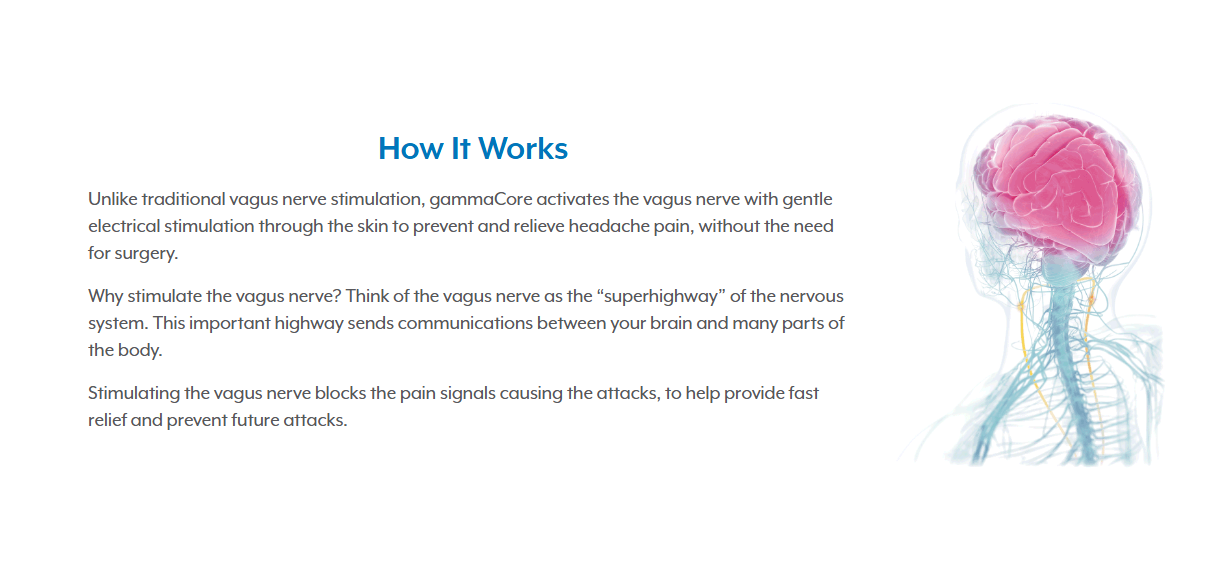
Neck-based stimulation reaches the vagus nerve through the side of the neck. That’s gammaCore’s route, and it’s what Truvaga and Pulsetto use as well. Those devices may be handheld or wearable, but reliable contact with the skin generally requires conductive gel or spray.
Ear-based stimulation targets the auricular branch of the vagus nerve, which runs close to the surface in parts of the outer ear. Nuropod clips onto the tragus, the small flap in front of the ear canal. A 2020 anatomical review supports the outer ear as a genuine access point and shows why exact placement matters. “Ear stimulation” isn’t one standard thing.
Neither stimulation is automatically better. The headache-specific research belongs to gammaCore, and it shouldn’t be transferred to Nuropod or to consumer neck devices as though the products are interchangeable.
Parasym-specific research provides encouraging safety data. A 2024 analysis published as a conference abstract in JACC reviewed seven studies involving over 200 cardiovascular patients using the Parasym Cardiac system. It reported no device-related serious adverse events; minor events, described as light tingling at the ear, occurred in 1.5% of patients. Tolerability did not differ between active and sham stimulation. Broader evidence supports this picture: a 2022 review of ear-based vagus nerve stimulation found no significant difference in adverse-event risk between active stimulation and controls, and no serious events causally linked to stimulation. These findings support tolerability within the populations and protocols studied.
Placement also changes the daily routine. A neck device needs gel and careful positioning. An ear clip stays put while you read, work, or wind down. That practical difference matters a lot.
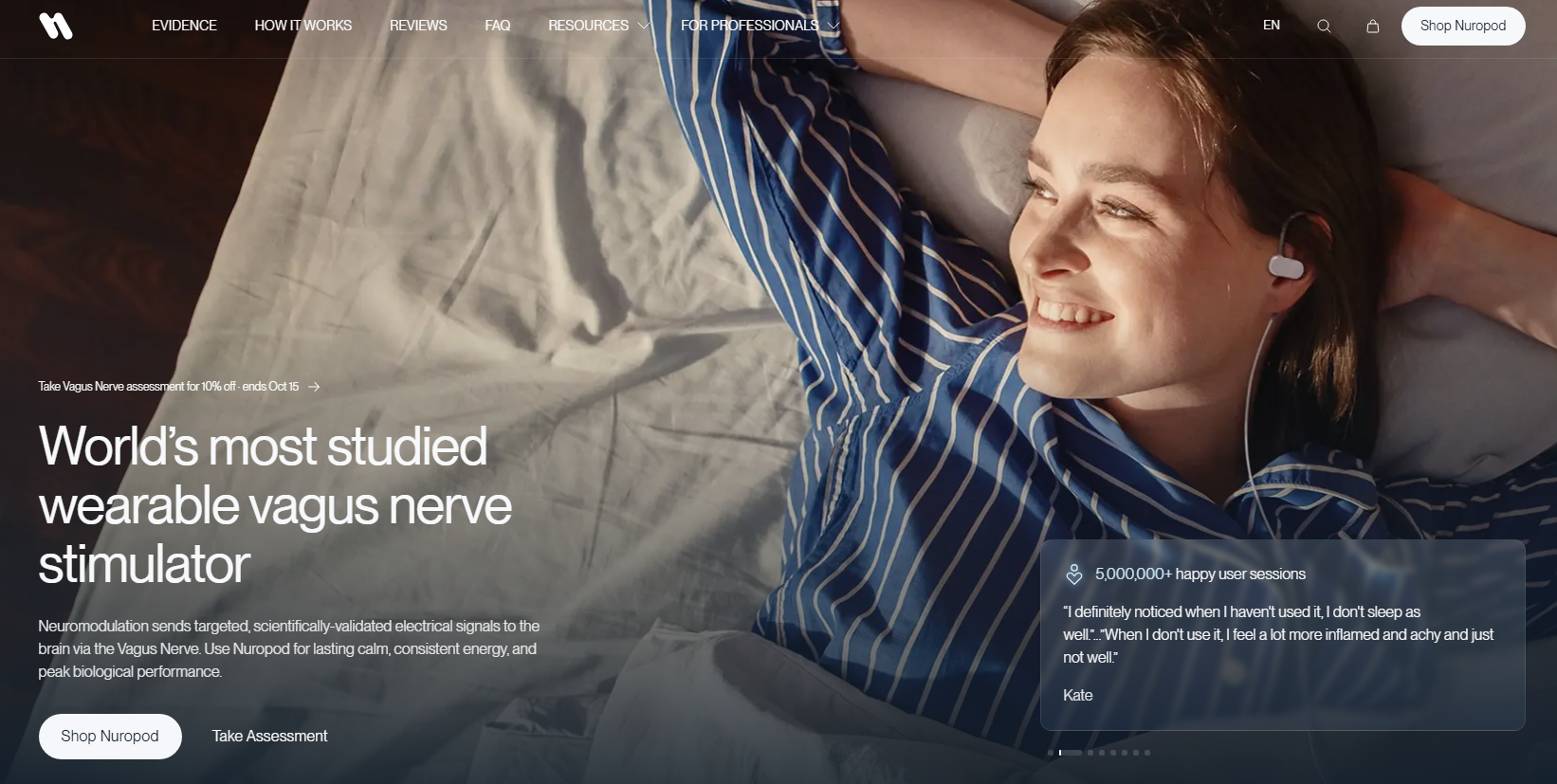
Nuropod: Best Overall Direct-to-Consumer Option
Nuropod uses Parasym’s Auricular Vagal Neuromodulation Technology (AVNT™), delivering electrical stimulation through an earpiece at the tragus. Researchers have used Parasym devices to study both nervous system activity and memory, alongside the safety research discussed above.
A 2024 randomized study involving 76 adults found greater improvements in immediate recall with active stimulation than with sham stimulation using a Parasym device. Delayed recall did not improve significantly. Participants were asked to use the device for four hours a day over two weeks, so those results relate to a different routine from a typical 30-minute consumer session.
There’s also research looking at heart rate variability. In a 2022 study, 14 healthy young adults received both active tragus stimulation and sham stimulation at the earlobe on separate visits. Several HRV measures were higher with active stimulation, including measures linked to parasympathetic activity.
These are useful examples of research testing Parasym devices against a comparison condition and measuring what changes. Parasym reports 60+ completed studies, 100+ ongoing studies, and 150+ research partners. That research background is one reason Nuropod is my overall pick, alongside the practical advantages of its ear-based format.
In practice, the earpiece sits at the tragus and sessions run from 15 to 60 minutes. Around 30 minutes is realistic while reading, answering emails, or winding down. There’s nothing to hold, no conductive gel, no required app, and no subscription.
At $900, it’s not a casual purchase. The 30-day money-back guarantee and the absence of consumable costs help, but the price still matters.
Nuropod is the best overall because it combines a defined electrical approach, a serious research program, and a format that’s easy to keep using. It is designed to help support nervous system regulation, relaxation, recovery, sleep, and focus. But it isn’t intended to treat the headache disorder for which gammaCore may have been prescribed.
Truvaga: Best If You Want Neck-Based Stimulation

Truvaga is likely to be the first alternative some gammaCore shoppers consider, for an obvious reason: it comes from electroCore, the same company. It also uses electrical stimulation of the neck in short 2-minute sessions.
The $325 Truvaga 350 comes with 350 sessions and needs no app, but the device is disposed of once those sessions are used. The $499 Truvaga Plus is rechargeable, requires a free app, and, according to the company, is designed for at least three years and 30,000 sessions. Both need conductive gel or spray and have to be held against the neck. Replacement six-packs cost $45.
The shared parentage matters, but only up to a point. GammaCore’s FDA clearances apply to gammaCore, not to Truvaga, which is sold as a wellness product. The company’s own evidence consists of a 30-day consumer in-home use test (not a clinical trial).
Truvaga makes sense if you specifically want the neck route and value a very short session. The trade-offs are needing to hold the device, using gel, and a thinner evidence base for this particular product than the family connection might suggest.
Pulsetto: Best For Lower Upfront Cost and Short App-Guided Sessions
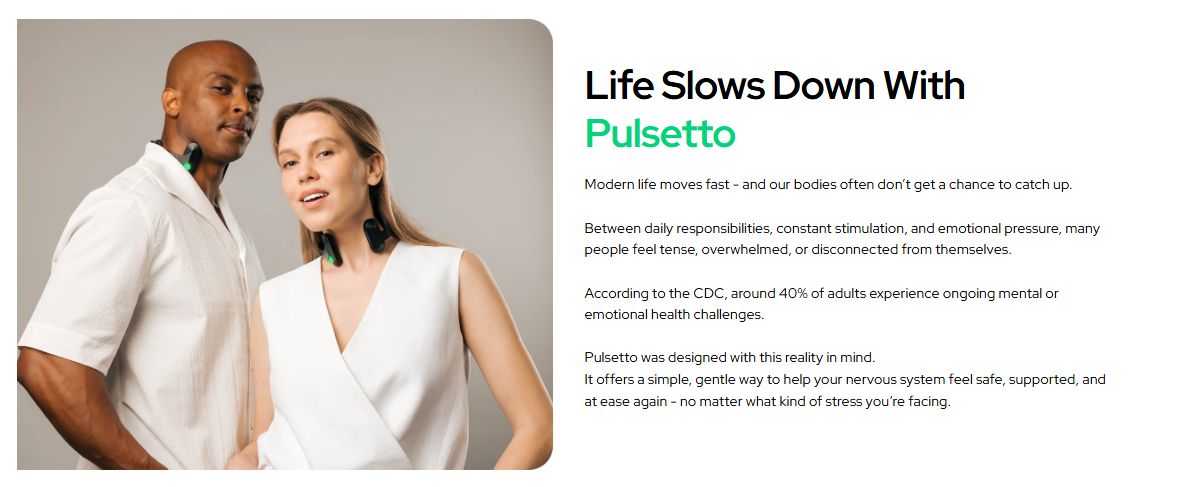
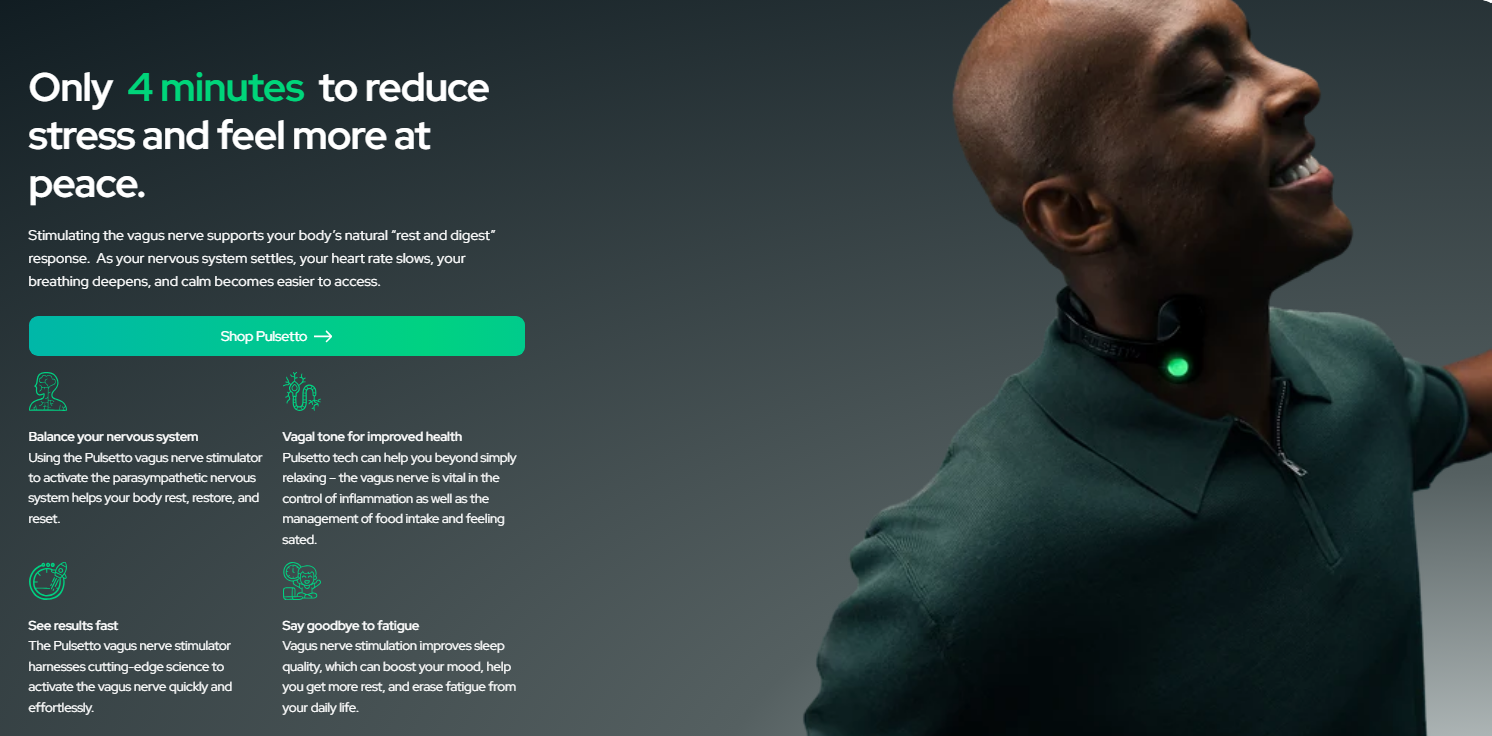
Pulsetto is a wearable neck device with two electrical contact points. It stays in place on its own, which gives it a practical advantage over a handheld device.
Its other attraction is price. At the time of checking, the Lite cost $269 and the FIT $296. The required app includes five core programs, with optional premium features. Sessions run from 4 to 20 minutes. The device connects over Bluetooth and needs conductive gel; Pulsetto says the included 60 g tube lasts about a month.
The trade-off is the evidence. Pulsetto points to research on the device itself, including a study it helped fund. That’s better than leaning on general vagus nerve research, but it isn’t the same as independent testing that someone else has repeated.
Pulsetto is a reasonable lower-cost choice if you want short, guided sessions and a hands-free neck format. I’d pick it for those practical features, not because every neck-stimulation study can be treated as evidence for this device.
Apollo Neuro: Best for Vibration-Based Relaxation
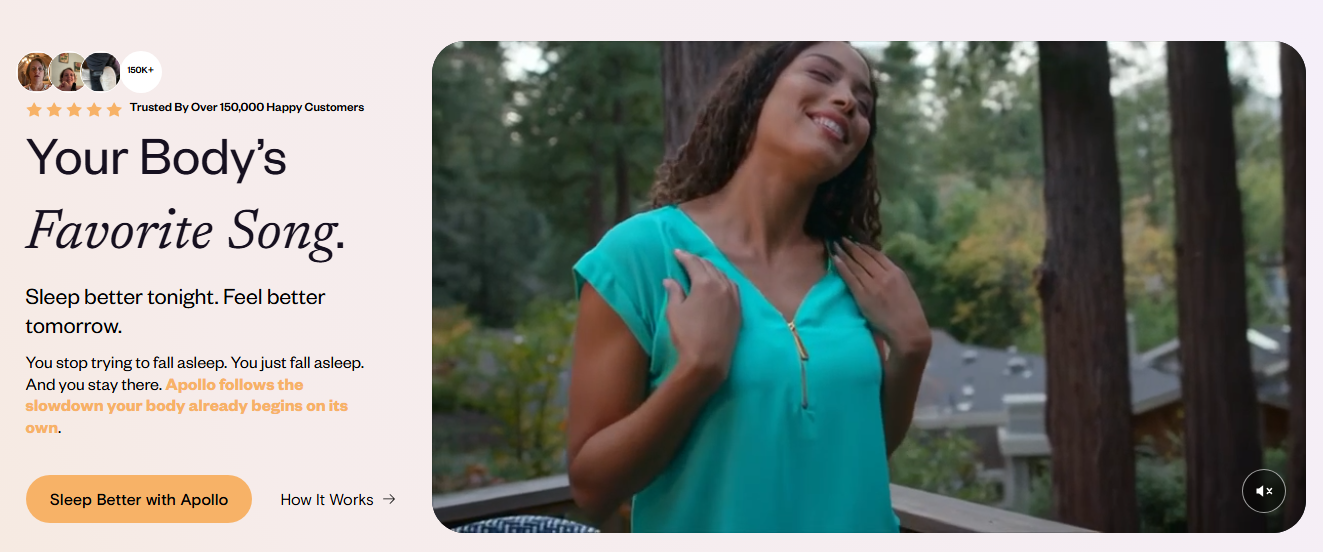
Apollo Neuro appears in this comparison because people shopping for nervous system support are likely to come across it. Technologically, though, it sits to one side of the other products.
It’s worn at the wrist or ankle, or clipped to clothing, and delivers patterned vibrations. It doesn’t electrically stimulate the vagus nerve at the neck or the ear. That doesn’t make it useless. It makes it a different kind of wellness wearable.
For someone who wants a discreet vibration-based device for calm, focus, energy, or sleep, that difference may be perfectly acceptable. The current $368 promotional price is for a $448 bundle that includes one year of SmartVibes AI; additional years cost $99. Just make sure vibration is what you intend to buy, rather than assuming that every product that uses “vagus nerve” language works the same way.
Which GammaCore Alternative Should You Choose?
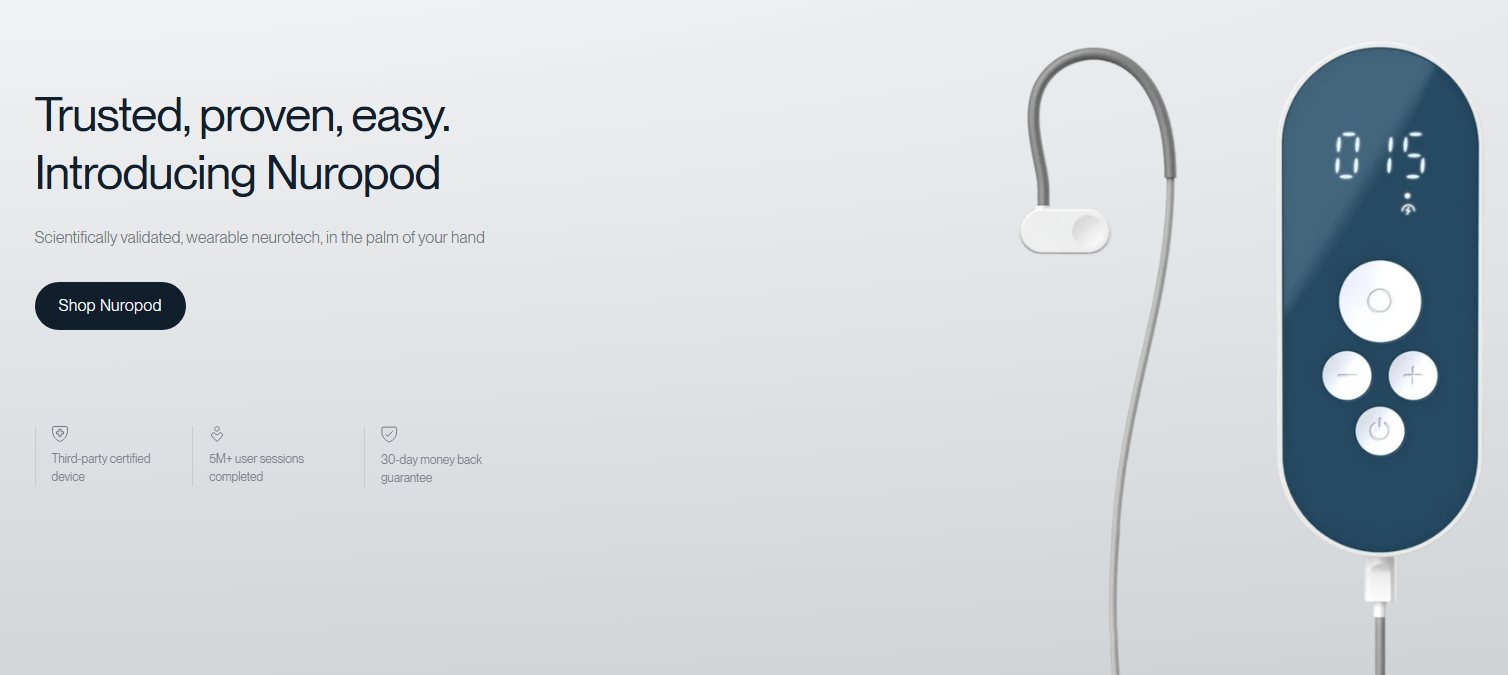
Choose Nuropod if you want direct-to-consumer electrical vagus nerve stimulation, precise tragus placement, no gel, and a substantial research program. It’s my overall pick if evidence and long-term usability matter more than the lowest upfront price.
Choose Truvaga if you specifically want neck-based stimulation from the company behind gammaCore, and 2-minute sessions matter more than hands-free use or avoiding consumables.
Choose Pulsetto if price, a wearable neck format, and short app-guided sessions are your priorities, while keeping its convenience separate from the strength of its evidence.
Choose Apollo Neuro if you want a vibration-based wearable and you’re comfortable moving away from electrical vagus nerve stimulation.
Whatever you choose, read that device’s contraindications first. Ask a healthcare professional if you have an implanted electronic device, a cardiac condition, are pregnant, or have another medical concern. And don’t use two stimulation devices at once.
What If Your Doctor Recommended GammaCore?
If gammaCore was recommended for migraine, cluster headache, or another diagnosed headache disorder, don’t assume a consumer wellness product is an automatic substitute. It isn’t.
Go back to the clinician and explain the access problem. Ask how to obtain the prescription, whether coverage or patient support is available, and what other medically appropriate options exist. GammaCore’s own resources include prescription information and a clinic finder.
That can sit alongside a separate consumer decision. If you’re also looking for an accessible, research-led device designed to support nervous system regulation, relaxation and recovery, Nuropod is the option I’d investigate first. They’re two different decisions, and it’s worth keeping them that way.
Final Verdict
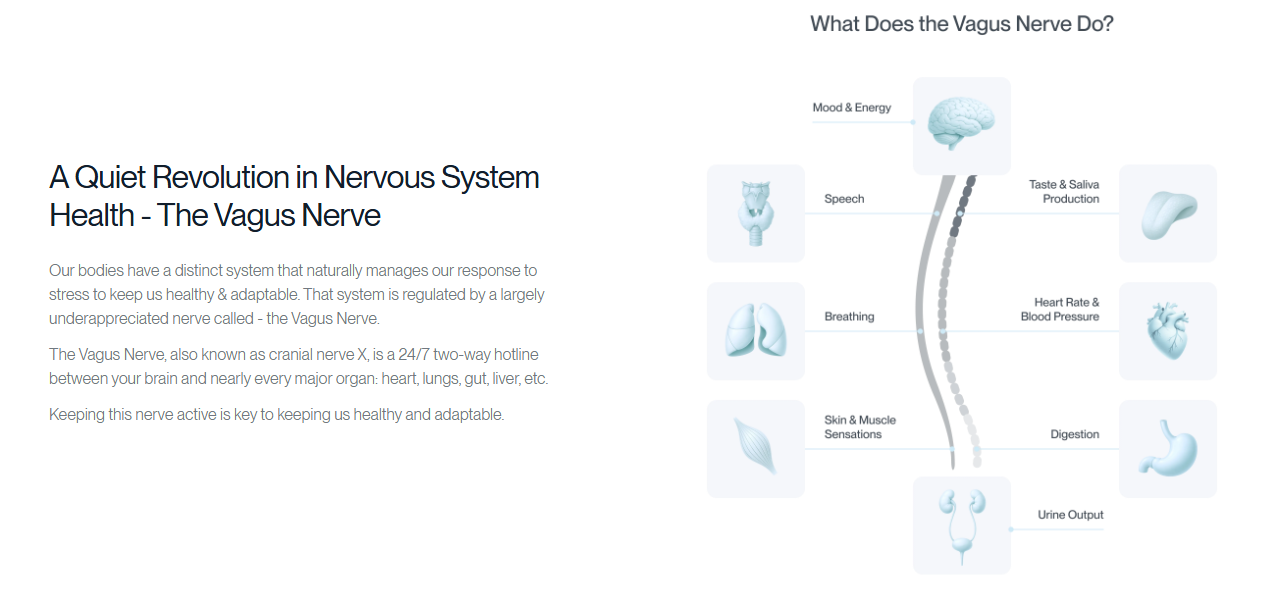
If you searched for a gammaCore alternative because the prescription requirement stopped you from simply buying gammaCore, the short answer is that there’s no like-for-like consumer version. GammaCore remains a distinct prescription medical device. Truvaga and Pulsetto offer accessible neck-based stimulation, while Apollo Neuro is a vibration wearable rather than an electrical stimulation device.
Nuropod is my strongest overall direct-to-consumer gammaCore alternative. It costs more, and its evidence still needs to be read with the same care as any other wellness product. But its researched ear-based approach, defined AVNT™ technology, hands-free format, and lack of gel give it the best balance of scientific credibility and everyday practicality.
Related Posts:



Danielle (Dani) Mathieu is a health and medical writer who works with global health and wellbeing businesses to deliver insight-driven, research-backed content at the intersection of psychology and nursing. She has 18+ years of experience in communications, holds an MA in Psychology, and is currently studying for an MSc in Adult Nursing.
Dani is happiest when she’s translating complex health and nutrition science into plain-English stories that feel genuinely useful without being overwhelming. When she’s not juggling clinical placements on the ward, she’s usually writing. She lives on the Scottish coast, loves a cold sea breeze, and is often accompanied by a very opinionated dog.