

The health coaching market has grown a lot, and also the noise around it. A quick search turns up a dozen programs, each promising career transformation and industry recognition. Some are rigorous, some are accessible, and some have a stronger reputation than others.
Filtering through all that noise is going to be key to helping you determine which certifications match your goals and needs. So, how can you select the best one?
Here, we are going to take an honest look at the top 6 health coaching certifications: ISSA, INN, ACE, and NASM. For each, we’ll run a brief overview, pros, cons, and current cost information.
The goal is to help you make a clear decision based on where you are now and where you want to be. Do keep in mind that accreditation status and board recognition details shift over time, so this information reflects what’s available as of August 2026.
What to Look for in a Health Coach Certification
Before comparing programs, it helps to know what we are evaluating, or what to pay attention to when selecting the best health coaching certification.

Accreditation and Board Recognition
This matters most for employer-facing roles. Programs that are accredited by organizations like the National Commission for Certifying Agencies (NCCA) carry more weight with gym chains, hospital wellness programs, and corporate HR departments.
If you plan to work independently, this doesn’t matter as much. However, it can still affect how clients perceive your credentials.
Format and Time Commitment
Online, self-paced programs are best for people with full-time jobs or family obligations. Structured cohort-based programs are going to be better for people who need that extra accountability to stay on track.
Neither option is going to be better; it all depends on you and the best way you learn. After all, you want to invest in something you are going to finish.
Cost and Payment Options
Some programs run under $1,000 with monthly payment plans. Others are going to push past the $7,000 for comprehensive tracks. Make sure you calculate the total cost, including any required renewals, continuing education, or exam fees. Don’t only consider the headline price.
Curriculum Depth
Generalist programs are going to give you an overview. On the other hand, specialized programs give you depth in one area. It’s all going to depend on the niche you are currently working with or planning on working with.
Career Support
There is a difference between those programs that just hand you your certificate and those that help you use it. Job boards, employer networks, alumni communities, and coaching marketplaces all add real value after you graduate.
The Best Health Coach Certifications (At a Glance)
| Provider | Best for | Overall Rating (TrustPilot) | Accredited/Board recognized | Format and Time Commitment | Cost and Payment Options | Career Support |
| ISSA | Coaches who want flexibility, affordability, and all-in-one programs | 4.617,000+ reviews | Yes, they offer an NBHWC health coaching certification | 100% self-paced. Most people finish in 4-6 months. | $79/month$1,188 one-time payment | Job-guarantee policies, gym-chain partnerships |
| INN | Aspiring holistic health coaches who don’t mind paying for a premium investment | 4.51,800+ reviews | Recognized by the NBHWC and ICF. | 100% online, self-paced, 6-12 month tracks. | $4,000-$7,000 depending on the package and promo | Alumni community, referral program, although some people report weak post-graduation support. |
| ACE | Coaches who want a client-centered, behavior-change model, recognized by gyms and healthcare companies. | 2.016 reviews | NCCA-accredited | Online self-paced. Commonly 8-12 weeks. | $799-$999, depending on the program you choose. | Listing on the US Registry of Exercise professionals, a large professional network, doesn’t offer a job guarantee. |
| NASM | Coaches who want the most recognized brand with a thorough curriculum. | 3.6157 reviews | NCCA-accredited | Online, self-paced.Commonly 8-12 weeks. | $1,100 to $1,500, depending on the program you choose. | Broad employer recognition, extensive CEU ecosystem, and no job guarantee policy. |
1. ISSA Health Coach Certification
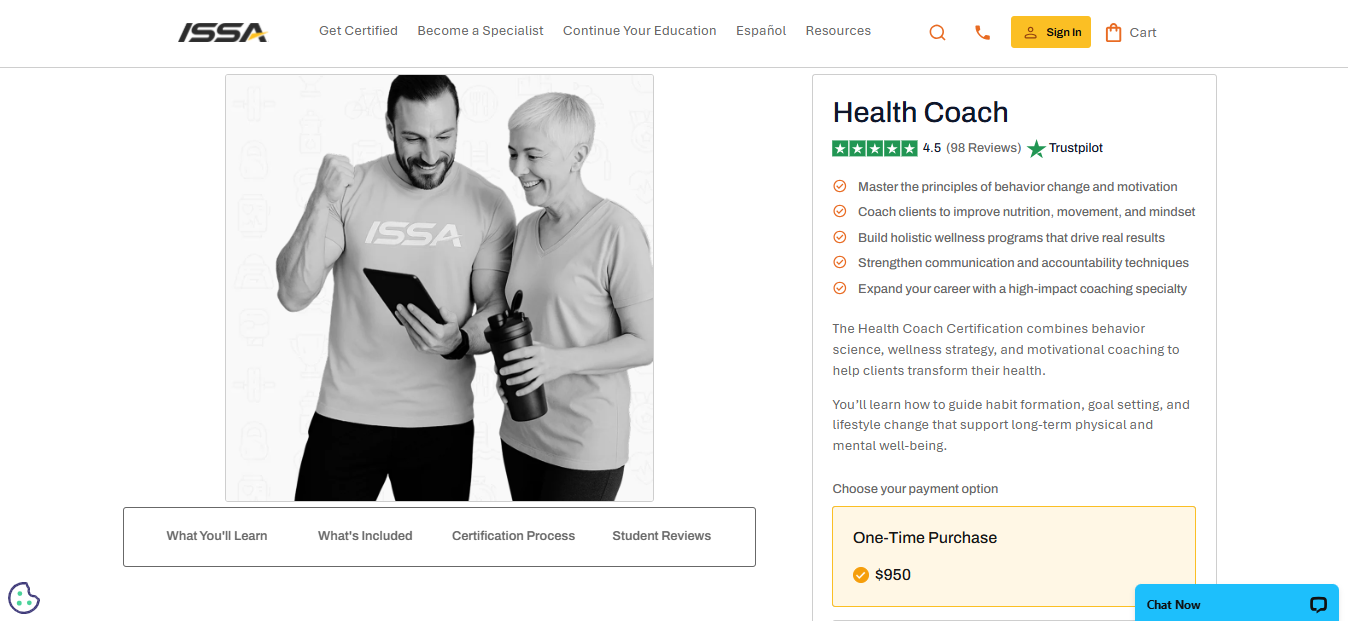
Best for: Aspiring coaches who want flexibility, affordability, and the option to expand into personal training or nutrition without having to switch platforms.
ISSA is one of the most established online fitness and wellness education companies in the world. The organization has certified more than one million professionals across 176 countries and offers a diverse range of programs, from personal training, health coaching, yoga, Pilates, and more than 25 specializations.
ISSA’s health coach certification focuses on lifestyle change, habit building, accountability frameworks, and mental and physical wellness integration.
Currently, they have an average star rating of 4.6 according to TrustPilot, with over 17,000+ reviews. Customers praise the well-organized and informative courses and their ability to do them at their own pace.
One of the things that makes ISSA stand out is its Career Connect feature, which connects certified professionals directly with employers that are actively hiring in the fitness and wellness space.
They have two health coaching certifications. What sets them apart is their accreditations. They offer a National Board for Health and Wellness Coaching (NBHWC) health coaching certification, which is widely respected in the industry.
The programs are designed with flexibility in mind, with their self-paced online learning structures. This allows students to access course material from anywhere, accommodating different schedules and commitments. The coursework is usually a combination of video lectures, reading assignments, interactive modules, and practical application exercises.
As for the cost, their health coach certification is approximately $79/month or $1,188 one-time. They also offer bundles that include personal training with nutrition coaching, making it a complete approach for those who want to have a more complete learning experience.
Pros
- Fully online with self-paced and 24/7 access.
- Multiple bundle options.
- Affordable monthly payment plans to help lower the barrier to entry.
- More than 25 specializations that let you select your niche down the line.
- Career Connect and a network of 23,000+ fitness center partner locations to support post-certification placement.
- Their Master Trainer bundle has a job-guarantee policy.
Cons
- Self-paced format, which requires self-discipline to complete.
- Smaller in-person community compared to campus-based programs.
2. INN (Institute of Integrative Nutrition)
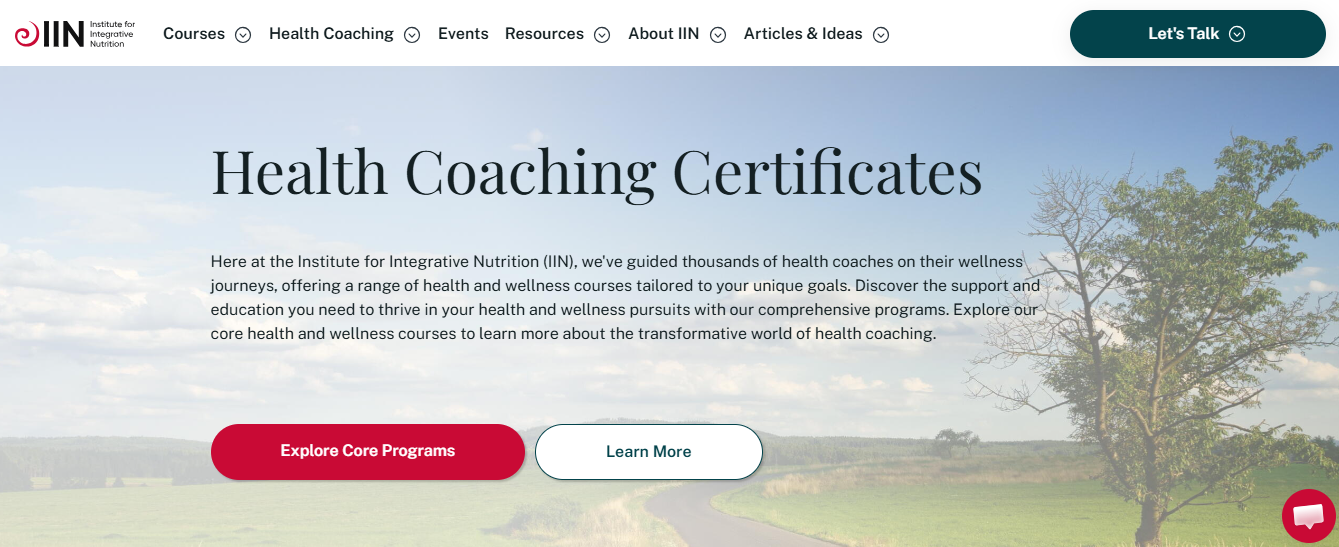
Best for: Coaches who want a holistic approach to health coaching, who want a strong peer community, and are comfortable with a premium investment.
INN is among the most recognized names when it comes to holistic health coaching. The program takes a broad view of wellness. Here, you not just cover nutrition and movement, but also relationship, career, spirituality, and environment.
INN’s signature concept, “Primary Food,” positions life satisfaction as a core driver for one’s physical well-being.
They offer different courses ranging from traditional health coaching to GLP-1 coaching and hormone health coaching. Their program is delivered entirely online, making it accessible for students all over the world. The curriculum is structured into interactive modules that you can complete at your own pace, typically within 6 or 12 months. They also offer the option of English or Spanish classes.
They have a 4.5-star rating on TrustPilot with over 1,800+ reviews. Overall, people seem to have a great experience and describe the journey as “life-changing.”
The program is accredited by the International Coaching Federation (ICF) and is also recognized by the NBHWC. These accreditations add credibility to the certification, ensuring that it meets industry standards.
INN’s health coaching training program typically runs between $4,000 to $7,000, depending on the payment plan and promotional planning. They offer monthly installments to make it easier to pay.
Pros
- One of the most comprehensive holistic wellness curricula available.
- Strong global alumni network with an active community.
- Well-recognized among wellness-focused employers and coaching clients.
- Covers a wide range of dietary theories, giving coaches flexibility in their client approach.
Cons
- Premium pricing makes it one of the most expensive options.
- Less clinical depth.
- Not designed for fitness professionals who also want to seek a fitness certification.
3. ACE (American Council on Exercise)
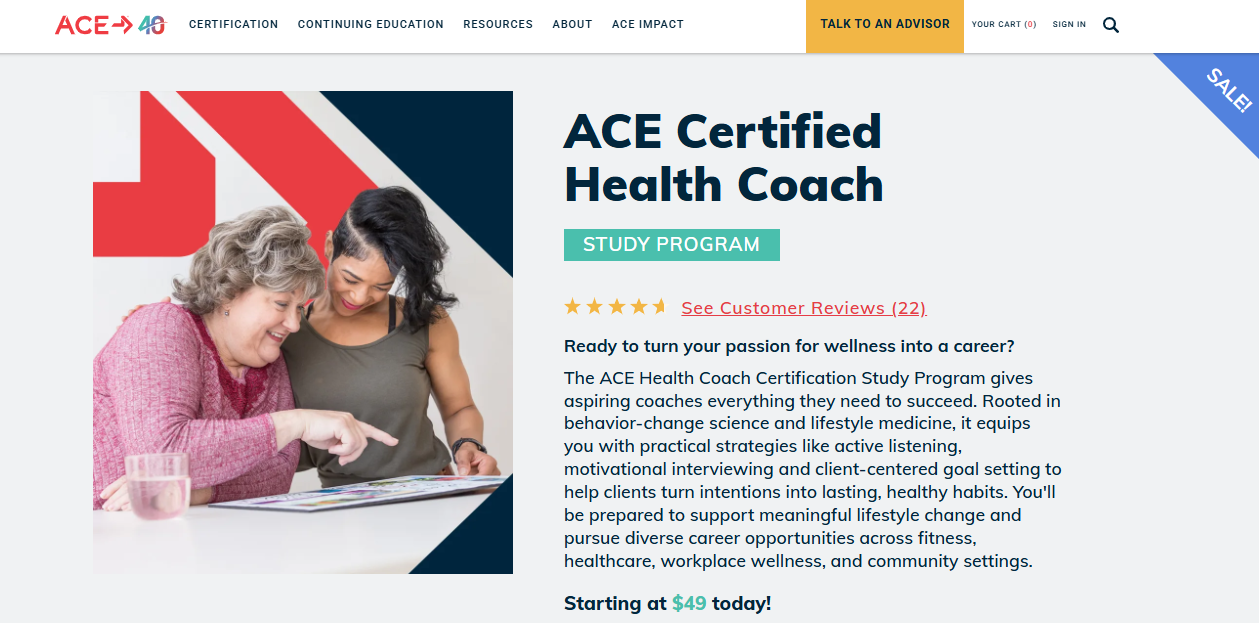
Best for: Coaches who want roles within established fitness or healthcare organizations where they need recognized credentials.
ACE’s health coaching certification is designed to complement clinical or fitness credentials by training coaches to support behavior change, chronic disease management, and long-term lifestyle improvement. They carry a great employer recognition, mainly in gyms and hospital wellness settings.
Their program is currently 100% online, where you get self-study materials such as textbooks, digital resources, and on-demand videos made to help different learning styles. They also provide practice exams, study guides, and access to online support.
The health coaching program is accredited by the National Commission for Certified Agencies (NCCA), which is a gold standard in the health and fitness industry. Health coaches is an ACE certification are also recognized as credible professionals who adhere to established guidelines.
Currently, they don’t have a strong TrustPilot profile. They have an average 2.0-star rating but with only 16 reviews.
ACE’s health coaching certification typically costs $799-$999. This is going to depend on whether you choose their basic program or their plus program. They do offer different bundles if you want to also get a fitness certification.
Pros
- Strong employer recognition, especially in gym chains and corporate wellness programs.
- Rigorous, evidence-based curriculum with a meaningful behavior change framework.
- Diverse specializations for continued development.
Cons
- The certification exam is competitive and requires thorough preparation.
- It does require continuing education, which can add long-term costs.
4. NASM (National Academy of Sports Medicine)
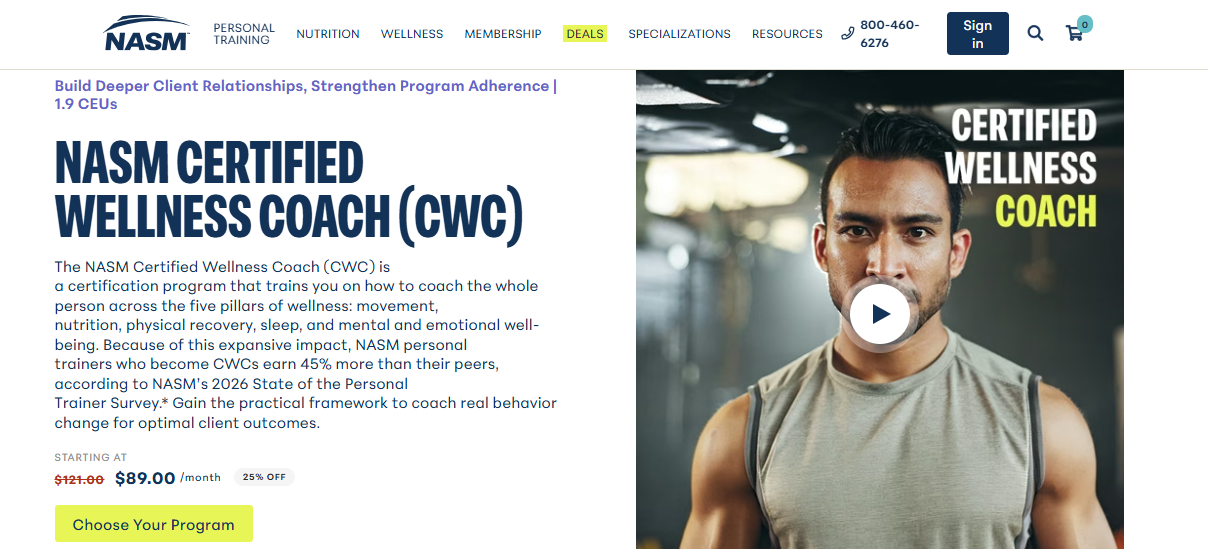
Best for: Professionals who want a credential and broad employer recognition and are willing to invest time and money for rigorous preparation.
NASM built its reputation on its Optimal Performance Training (OPT) model, which is a structured, science-backed approach developed for personal trainers. Its Certified Wellness Coach (CWC) focuses on behavior change, stress management, sleep, and lifestyle coaching.
They offer a flexible, self-paced education format, making it great for those with varying schedules. The program is fully online with a mix of interactive videos, reading materials, quizzes, and case studies. Additionally, you get access to an online learning platform and customer support, ensuring you can stay on track throughout the course.
Their Certified Wellness Coach is widely recognized in the industry since it’s NCCA-accredited. This ensures rigorous standards for quality, knowledge, and professionalism.
Just like ACE, they don’t have a strong reputation on TrustPilot. They have an average 3.6-star rating but with only 157 reviews.
Their program typically ranges from $1,100 to $1,500, depending on the package you choose. You might be able to get different promotions, and they do offer monthly payments.
Pros
- Highly regarded by employers across fitness, wellness, and healthcare sectors.
- Rigorous curriculum that prepares the coach for complex client scenarios.
- Strong sports science foundation.
- They offer different specializations like nutrition, corrective exercise, or performance.
Cons
- Higher coast than other competitors.
- Demanding study requirements.
- They request monthly education requirements, which might increase the long-term cost.
Deciding Which Certification is Best for You
Honestly, the best option is going to depend on your current goals and needs. Programs that appear similar on the surface can differ significantly in curriculum depth, employer recognition, and long-term career utility.
All the programs we reviewed here (ISSA, INN, ACE, and NASM) all offer different approaches to the same profession, and the best is going to depend on where you’re starting and where you want to go.
So, before you enrol in any program, verify the current accreditation status and board recognition directly with the organization. And, if the budget is a factor, make sure you compare the full cost, including renewals and continuing education requirements (not just the enrollment fee).
However, the investment in a strong certification pays off when the credential matches the career. That’s why you need to take your time deciding which is the best option to get that alignment just right.
Related Posts:






Brenda Peralta is a Registered Dietitian Nutritionist and Certified Diabetes Educator with over a decade of experience in clinical nutrition, health coaching, and evidence-based wellness. She specializes in weight management, metabolic health, diabetes care, and sustainable lifestyle changes. Brenda breaks down complex nutrition science into clear, practical guidance that helps readers make informed choices to improve their health.