
Women’s health is one of the fastest-growing specialties in fitness, and it’s about time. Before becoming a full-time writer, I spent years in the fitness industry as a certified group fitness instructor, mat Pilates instructor, and spin instructor. I even dabbled in Zumba.
During that time, I worked with women in every stage of life, from young adults just beginning their fitness journey, to postpartum moms trying to reconnect with their bodies, to women navigating hormonal changes that seemed to affect everything from their energy levels to their ability to recover from workouts.
One thing I realized is that most general personal training certifications don’t spend nearly enough time discussing the unique physiological changes women experience throughout their lives.
As awareness continues to grow around topics like pregnancy, postpartum recovery, perimenopause, and menopause, more clients are actually starting to seek trainers who understand these transitions.
However, now there are multiple certifications competing for your attention, and they all approach women’s health from slightly different angles. Some focus heavily on fitness programming. Others emphasize coaching and behavior change. Some cover the entire female lifespan, while others focus specifically on menopause and hormonal health.
If you’re trying to decide which certification is worth your time and money, here’s how the leading options compare.

Our Top Picks
- Most Comprehensive: Girls Gone Strong Women’s Coaching Certification
- Best for NASM Trainers: NASM Women’s Fitness Specialization
- Best for CEUs: ACE Women’s Health Courses
- Best for Menopause Coaching: ISSA Menopause Coach Certification
At a Glance: Best Personal Trainer Certifications for Women’s Health
| Certification | Best for | Primary Focus | Format |
| Girls Gone Strong Women’s Coaching Certification | Comprehensive women’s health education | Women’s health across the lifespan | Online |
| NASM Women’s Fitness Specialization | Existing NASM trainers | Fitness programming for women | Online |
| ACE Women’s Health Courses | Continuing education | Topic-specific learning | |
| ISSA Menopause Coach Certification | Midlife and menopause specialists | Perimenopause and menopause coaching | Online |
What Makes A Good Women’s Health Certification?
Not all women’s health certifications are created equal.
The best programs go beyond just explaining female anatomy and hormonal cycles. They should help trainers understand exactly how those physiological changes can impact exercise, recovery, nutrition, and long-term health outcomes. So, when you’re evaluating certifications, consider these:
Scientific Accuracy
This is probably the most important factor to consider, as women’s health is an area filled with misinformation, useless trends, and social media myths. Look for programs grounded in current evidence rather than anecdotal claims.
Practical Coaching Application
Sure, knowledge is important, but being able to apply the knowledge is what matters even more. A good certification should help you translate the scientific jargon and education into real-life coaching strategies that you can use with your client and they’ll be able to understand.
Life Stage Coverage
Women’s health is a very broad term. Some certifications focus exclusively on menopause. Others may cover pregnancy, postpartum recovery, menstrual health, and aging/longevity.
Think about what population you actually want to serve before choosing a program, as the type of education you’ll receive will vary greatly.
Career Value
To add to that, you need to ask yourself if this specific certification will help you attract clients, new or existing. Will it differentiate your services from competitors? Does it expand your expertise in an area that seems to be in demand where you live? These are all questions that matter nearly just as much as the curriculum itself.
Girls Gone Strong Women’s Coaching Certification
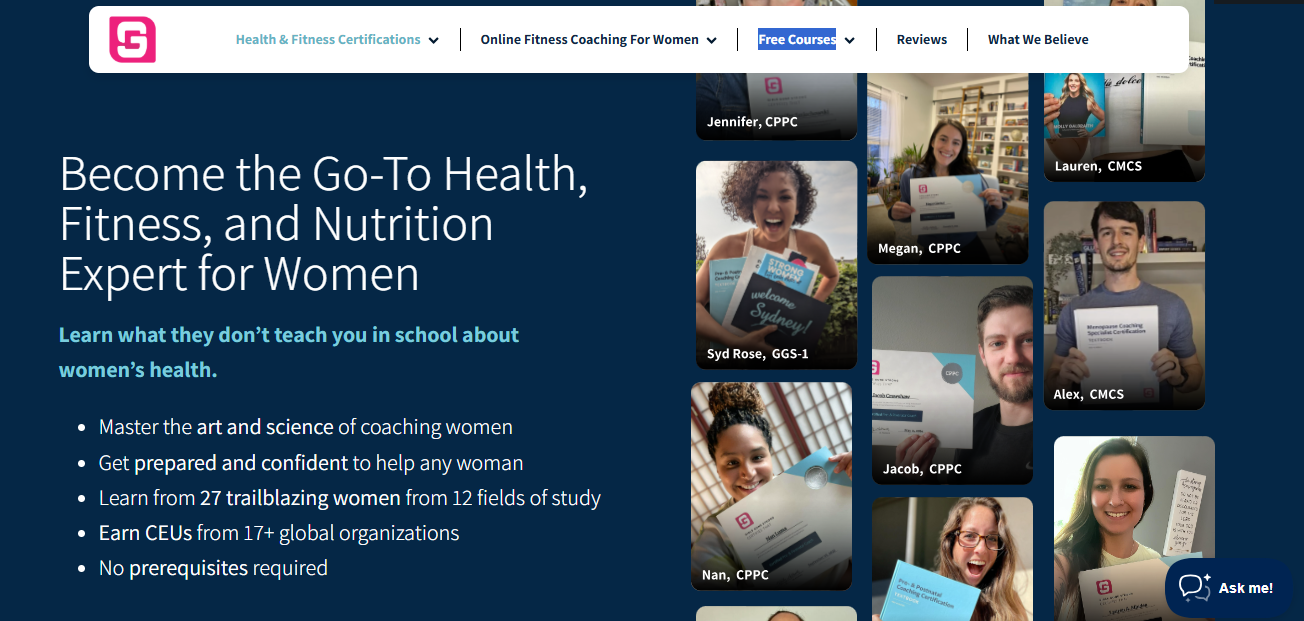
If your goal is to gain the broadest possible education in women’s health, Girls Gone Strong is an excellent choice to consider. Girls Gone Strong takes a broader coaching approach, with a curriculum that covers topics like female physiology, pregnancy, postpartum recovery, pelvic floor considerations, nutrition, behavior change, and coaching psychology.
The goal for a program like this is to help trainers understand the unique biological, emotional, and lifestyle factors that can influence a woman’s health and fitness journey, not just “designing workouts for women.”
One of the biggest strengths of the program is its lifespan approach. Instead of focusing on a single phase of life, it follows women through multiple stages, making it appealing for coaches who want to work with clients long-term. A trainer could potentially use the knowledge from this certification with a young professional, a pregnant client, a postpartum mother, and a woman entering menopause.
The tradeoff is that this certification would be a significant investment of both time and money. For trainers who only want to learn more about a specific niche, such as menopause or pregnancy, the curriculum may feel broader than necessary. However, if you’re looking for one that focuses on a good foundation of women’s health, this is one to consider.
Here’s an extensive list of what you can coach your client through using this certification:
- Menopause
- Perimenopause
- Menstrual cycle
- Pelvic health
- Pelvic floor
- Body image
- Disordered eating
- Emotional eating
- Unexplained weight gain
- Pregnancy
- Postpartum
- Diastasis recti
- Endometriosis
- Hormone issues
- PCOS
- Hashimoto’s
Pros
- Extremely comprehensive
- Study at your own pace
- Covers multiple life stages
- No prerequisites required
- Try it for free for 60 days
Cons
- Significant time commitment
- One of the more expensive options available
NASM Women’s Fitness Specialization
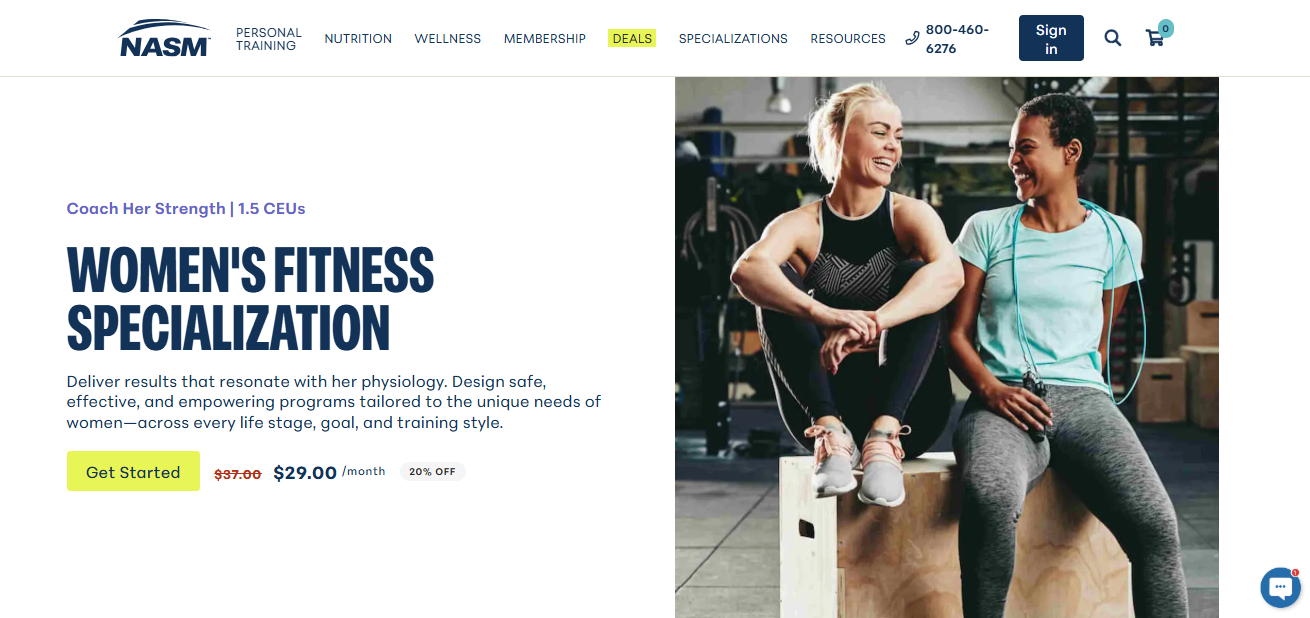
The NASM Women’s Fitness specialization is often the natural next step for trainers who are already certified through NASM and want to deepen their understanding of female clients.
Compared to Girls Gone Strong, NASM approaches women’s health from a more traditional fitness perspective. The curriculum focuses heavily on exercise programming, physiological differences between men and women, hormonal considerations, pregnancy modifications, and training strategies that support female-specific fitness goals.
This is a certification that would appeal to a personal trainer who spends most of their time designing workouts and helping clients improve performance, body composition, or overall fitness. It doesn’t dive that deeply into coaching psychology or lifestyle intervention, with a focus on a practical program design.
One advantage is that trainers already working within the NASM ecosystem will find the structure and educational style very similar to their original certification experience. That can make the learning process feel more approachable and immediately applicable.
However, this certification may lack in depth in some places, like how it won’t explore intensively as some of the more specialized certifications on this list. If you’re hoping to build an entire niche around women’s health, you may eventually want to add additional education beyond this specific program.
Pros
- Familiar structure for NASM trainers
- 100% Online & Self-Paced Program
- Recognized brand
Cons
- General education
- Not focused on any specializations
ACE Women’s Health Courses
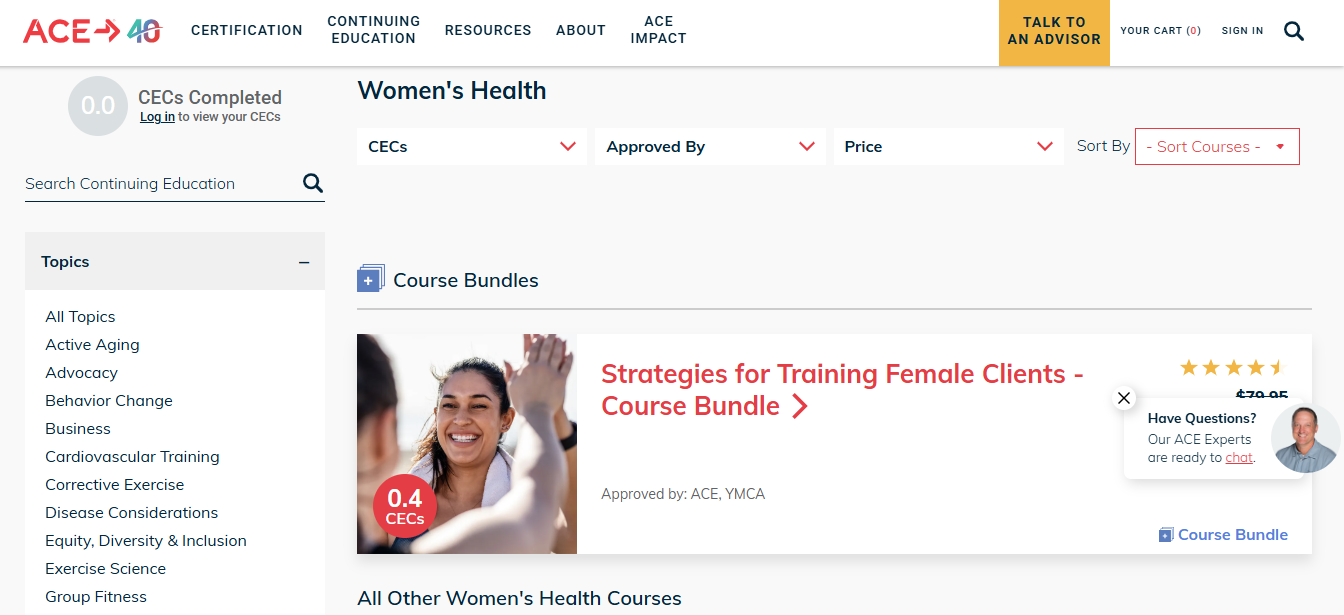
ACE takes a different approach altogether. Rather than offering a single generic women’s health certification, ACE has a collection of courses and continuing education opportunities that allows trainers to build their knowledge over time. This could be appealing if you aren’t ready to commit to an entire certification program, but still want to strengthen your expertise.
The ACE approach works best for trainers who already have a solid foundation and just want to add on or fill in areas where they have gaps. For example, you can take a course focused on pregnancy or one focused on aging/longevity depending on the clients you are currently serving.
Because these courses are designed as continuing education, they tend to be shorter and easier to digest than more comprehensive certifications. Which is especially helpful if you have a busy schedule, but it may leave you feeling like you’re having a bit more fragmented educational experience.
Here are some of the courses they offer:
- Buff Bones® Instructor Training (a comprehensive movement system for bone and joint health)
- Coaching and Training Women
- Core Training Essentials for Pregnancy and Postpartum
- Effective Pre/Postnatal Client Assessment Strategies
- Menopause Mentor
- Oh Baby! Fitness® Pregnancy and Postpartum Exercise Instructor Training
- Prenatal Fitness for Two
- Stand Strong: Building Postnatal Core Strength Through the Feet
- Training Female Clients Through Different Life Stages
- Training Women for Optimal Health and Performance
- Using Lifestyle Medicine to Manage Hormonal Changes
- Weightlifting for Women
If your goal is to develop a broader women’s health specialty that becomes a cornerstone of your business, ACE may feel less comprehensive than some of the dedicated certifications available. Although if you are already certified by ACE, you’ll need to keep up your certification with CEUs anyway, so it might make sense to take these courses.
Pros
- Good option for earning CEUs
- Lower commitment
- Flexible learning path
Cons
- Less comprehensive overall
ISSA Menopause Coach Certification
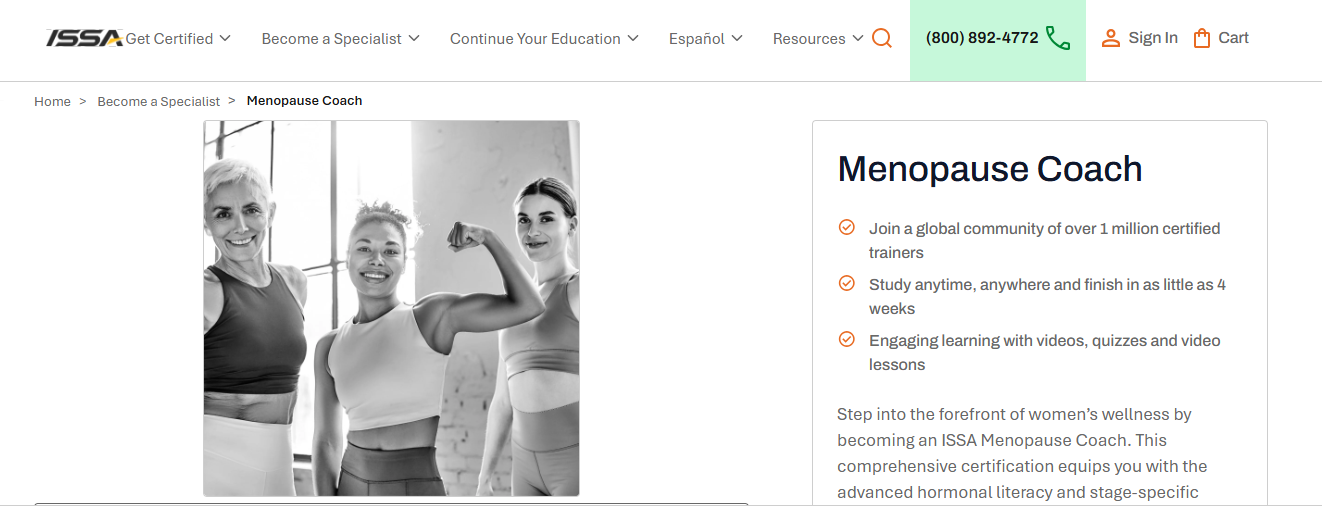
While many women’s health certifications discuss menopause briefly, ISSA’s Menopause Coach Certification places it front and center.
The reason this is so meaningful is because it really shows that women’s health is no longer just a niche, or worse, general topic in fitness. Women entering perimenopause and menopause represent one of the fastest-growing demographics in the industry, yet many may find themselves struggling to find professionals who understand how hormonal changes affect energy levels, body composition, recovery, sleep quality, strength gains, and overall well-being.
This certification from ISSA is designed to specifically address this. It doesn’t treat menopause purely as a medical topic, but focuses on the actual practical coaching side of the equation. Trainers will learn how hormonal changes can influence fitness outcomes and how to support your clients through these transitions using evidence-based exercises, lifestyle, and behavior-change strategies.
I really appreciate the emphasis on the real-world. Sure, you will be able to understand the science of menopause, but you will also learn how to confidently work with women who may feel frustrated because the strategies that worked in their thirties and forties no longer seem effective.
This may appeal to trainers looking to specialize in a growing client segment. Midlife women are actively searching for coaches who understand their current experiences, but because this is a newer “hot topic”, fewer fitness professionals have formal education in this area. By developing expertise in menopause coaching (and promoting yourself as such), you can position yourself within a rapidly growing and underserved niche.
Another advantage is accessibility. Compared to broader coaching certifications, the ISSA pathway might feel more approachable for trainers looking to add a specialty without having to commit to a multiple-month program.
The biggest limitation here actually could be that it is so specialized. If you’re seeking to just expand your education for things like pregnancy, postpartum, or broader women’s health, you can pair this course with additional coursework focusing on those. But if you’re specifically interested in helping women navigate midlife hormonal transitions, ISSA offers the most targeted options currently available.
Pros
- Focuses on a growing niche
- Online and accessible
- Fitness-first perspective
- Designed for an underserved population
Cons
- Might be too specific for some trainers
- Less pregnancy and postpartum content
Women’s Health Specialization Matters Now More Than Ever
Women’s health is no longer a niche we don’t talk about. People are increasingly informed now. We’re reading research, listening to podcasts, joining online communities, and looking for professionals who understand our specific experiences.
Specialization allows you to better serve female clients, differentiate yourself in a crowded market, build trust more quickly, develop a stronger niche, and expand your career opportunities.
As more women seek trainers who understand pregnancy, postpartum recovery, hormonal changes, and healthy aging, specialized education can help bridge that gap that many clients struggle to find support for. Investing in women’s health is no longer just a “nice addition” to your resume. It’s a meaningful way to serve and connect with your clients, building a specialized fitness career.
Related Posts:





Stephanie Hope is a Certified Sleep Science Coach with additional training in stress management and longevity coaching. With over a decade of experience in digital media, she has created wellness, lifestyle, and commerce content for brands like Fortune, Reader’s Digest, and BuzzFeed. Stephanie is passionate about helping readers find practical strategies that support healthier daily living.