

Ask a few people what they pay for menopause hormone therapy, and the answers can be so far apart they hardly sound like the same treatment. Much of that gap has nothing to do with the hormone.
With a pharmacy coupon, some generic estradiol tablets work out to about $7.50 to $8.30 for 30 days when you buy 90 tablets at a time. Four weeks of some generic patches cost about $27 to $40. So a month of estrogen medication can run from under $10 to about $40 in these examples. The care around it is where the bill grows. A first visit at Midi Health, for example, costs $250 if you’re paying out of pocket.
This guide covers U.S. prices for hormone replacement therapy (HRT) for perimenopause and menopause, checked November 24, 2026. Testosterone therapy for men, gender-affirming hormone therapy, and fertility treatment have their own pricing.
What Makes Up the Cost of HRT?

The first quote you get may cover just one part of your care. Depending on where you’re treated, the prescription, the follow-up visits, and any lab work can each arrive on a different bill.
| How you get care | What you pay for | What to check |
| Doctor’s office and pharmacy | An office visit and a pharmacy fill | Whether there’s a facility fee and what your pharmacy charges |
| Visit-based telehealth | Initial and follow-up appointments, plus medication | Which visits, labs, and prescriptions your insurance covers |
| Online treatment subscription | Recurring payments for medication, sometimes with a separate intake fee | When refills are billed and whether clinician support and shipping are included |
| Broader health membership | A program fee that can cover testing, consultations, and coaching | What you would pay for a prescription or extra testing |
The Price of the Hormones Themselves
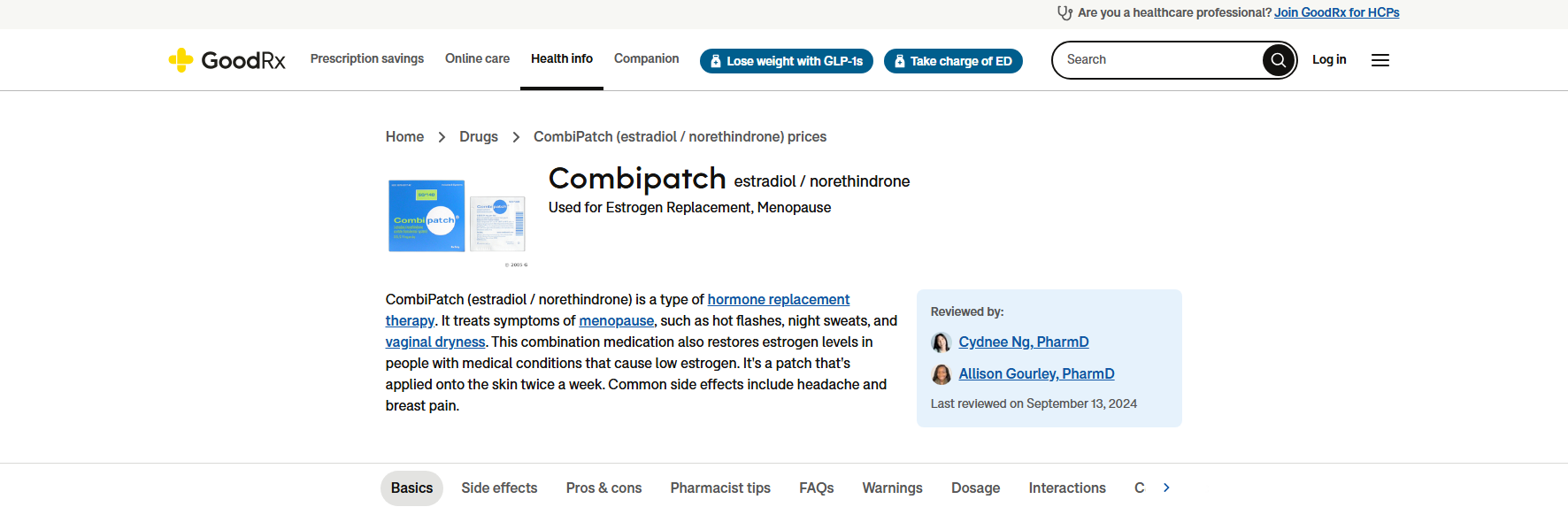
GoodRx lists these coupon prices for estradiol, progesterone, and CombiPatch for specific products and package sizes. Your own price will depend on the pharmacy, your ZIP code, and the strength you’ve been prescribed.
| Medication | Example coupon price | What you get |
| Generic estradiol tablets | $22.44 – $24.83 | 90 tablets (0.5 mg to 2 mg). |
| Generic estradiol patches | $26.72 – $40.22 | Four weeks of selected once- or twice-weekly patches. |
| Generic estradiol gel | $169.38 | Three 50 g pumps of 0.06% gel. How long they last depends on your prescription. |
| Generic vaginal estradiol cream | $36.92 | One 42.5 g tube. How long it lasts depends on your prescription. |
| Generic progesterone capsules | $16.25 | 30 capsules of 100 mg. Refill timing depends on how it’s prescribed. |
| Brand-name CombiPatch | About $248 | Eight patches containing estrogen and a progestin. |
Low-dose vaginal estrogen can treat local symptoms such as vaginal dryness. Systemic estrogen, including pills and patches, acts throughout the body. If you have a uterus and take systemic estrogen, you’ll generally also need a progestogen to protect the uterine lining, either as a separate prescription or in a combination product, as The Menopause Society explains.
Buying 90 tablets at once usually lowers the price per tablet, though you pay for all of them up front. Patches and creams are trickier, because one box or tube can last longer than another depending on the prescription. And if you’re using telehealth, ask whether the prescriber can send refills to whichever pharmacy quoted you the best price.
What Does Online HRT Cost?

Midi Health charges self-pay patients $250 for the first visit and $150 per follow-up. Lab work and medication are billed separately. Midi also bills participating insurance plans, so what you owe for a visit comes down to your coverage.
Alloy lists its estradiol patch at $100 for a month’s supply, but it ships and bills every three months, which works out to $300 per shipment. There’s also a one-time $49 consultation fee to get started. Standard delivery is included, and so is messaging with your doctor while your prescription is active.
Winona charges by treatment and includes consultations, follow-ups, and standard shipping. Its advertised prices start at $54 per month for estrogen tablets, $89 per month for a compounded estrogen and progesterone body cream, and $149 per month for an estrogen patch. Add a second product and the bill goes up.
Those “per month” figures deserve a second look if you’re comparing Winona with a service that bills by the calendar month. Winona’s FAQ says it processes payment for a 30-day supply every 28 days and for a 90-day supply every 84 days. Over 52 weeks, a 28-day cycle means 13 payments, not 12.
If you’re quoted a price for compounded HRT, ask your clinician why that formulation was chosen. Compounding can meet an individual need when the available FDA-approved options are unsuitable. But compounded drugs aren’t FDA-approved, and the FDA doesn’t review them for safety, effectiveness, or quality before they reach the market. “Bioidentical” isn’t a synonym for compounded, either. As The Menopause Society points out, many well-tested, FDA-approved hormone products also fit the term, including forms of estradiol and micronized progesterone.
Paying Through Your Own Doctor

If your usual clinician already handles menopause care, this can be the simplest route. Their office can tell you what the first visit and a follow-up will cost, though the number can shift depending on whether you’re billed as a new or established patient, and whether the practice adds a facility fee. The prescription and any lab work come on top.
No insurance? Your local community health center may offer menopause care, and federally supported centers set fees on a sliding scale based on income and family size.
Does Insurance Cover HRT?

Coverage depends on your plan, and the pieces don’t always line up. You can have an in-network visit and still owe a substantial amount for the prescription or lab work. Before you call your insurer, have the clinician’s name and the exact drug, strength, form, and quantity in front of you. It makes the conversation much shorter.
Visits and labs. An initial visit and a follow-up can cost very different amounts before and after you meet the deductible. If tests are ordered, check that the lab is in network too, not just the clinician.
Prescriptions. Start with the formulary, your plan’s list of covered drugs. Some HRT products need prior authorization, and some plans charge less at a preferred pharmacy.
Don’t assume the insurance price is the lowest one. Pharmacies can quote you both the insurance price and the cash or coupon price for the same fill, and sometimes the coupon wins. If you pay with a GoodRx coupon, some plans will let you submit the receipt for credit toward your deductible.
Will Blood Tests Add to the Bill?

Not necessarily. The Menopause Society says testing hormone levels isn’t required to tell whether you have the “right amount” of hormones. Levels vary from day to day, and even over the course of a day, so one blood test can’t give an accurate picture. Your clinician may still order targeted tests if your symptoms or medical history call for them.
When tests are ordered, expect a separate lab bill. For a sense of scale, Labcorp OnDemand lists a thyroid-stimulating hormone test at $49 and a standard thyroid panel at $89 as retail self-pay prices. Going over the results may mean another visit, too.
When HRT Is Part of a Broader Membership

Lifeforce takes a different approach from the services above. Instead of pricing a single prescription, it’s a health and longevity membership you can use alongside your usual care, built around testing and follow-up over time.
Its main membership page lists an introductory $199 to start, followed by $149 per month. For that, a phlebotomist comes to your home four times a year to draw blood for a panel of 50+ biomarkers, which on its menopause page includes estradiol, testosterone, DHEA, and thyroid markers. Each draw is followed by a clinician consultation to go over the results, and you get unlimited health coaching in between, plus 30% off supplements. Lifeforce also lists a Core Annual plan at a one-time cost of $599, with two blood draws and one clinician consultation.
That makes it the only option in this guide where regular blood work and scheduled clinician time are part of the price. Midi bills labs separately, and neither Alloy nor Winona lists lab testing in its price. For comparison, one initial Midi visit plus three self-pay follow-ups would total $700 before labs. The testing is a feature of the membership, not something HRT requires. It suits people who want to keep an eye on a wider set of markers, such as thyroid function, with a clinician who knows their history.
A Lifeforce clinician can discuss prescription options after assessing you, and prescriptions are delivered to your door. The medication is paid for separately from the membership, so it’s worth asking for the price once HRT is prescribed, and confirming that Lifeforce can provide that treatment in your state. Its pharmacy information page explains how prescriptions are filled.
If all you want is a prescription and the odd check-in, a simpler route will usually cost less. The membership earns its price if you’d use the testing, consultations, and coaching.
What Could Your First Year of HRT Cost?

These examples show the cost of one estrogen patch prescription and the care described for each service, assuming prices stay the same. Extra prescriptions, tests, or visits would add to each total.
Pay per visit and fill at a pharmacy. At Midi’s self-pay rates, a $250 first visit and a lower-priced patch box at about $30 come to about $280 to start. With one $150 follow-up and 13 four-week boxes, you’d pay about $790 over 52 weeks, before tax and any delivery fees.
Pay for three months at a time. Alloy’s first three-month shipment, at $100 a month, and the $49 consultation come to $349 to start. Four shipments plus the consultation add up to $1,249 over 12 months.
Pay every four weeks. If your Winona quote is $149 per order and you’re billed every 28 days, 13 payments come to $1,937 over 52 weeks. A different product or billing interval would change that.
Pay a membership, then the prescription. The $199 introductory payment plus 11 monthly charges of $149 puts the Lifeforce membership at $1,838 for the year, before medication. Add 13 four-week boxes of generic patches at a coupon price of about $30 each, and the example comes to about $2,230. That’s the highest total here, but it’s also the only one that includes four rounds of blood work, four clinician consultations, and year-round coaching. The other three cover the prescription plus a consultation or two, or messaging with a clinician.
The Bottom Line

For a lot of people, the hormone is the cheapest part of HRT. What you’re really choosing is how much care you want around it. If a prescription is all you need, the leaner options make sense. If you want regular testing and someone tracking your results with you, a broader membership puts more of that care into one fee. Either way, the number worth comparing is what a full year costs.
Related Posts:






Danielle (Dani) Mathieu is a health and medical writer who works with global health and wellbeing businesses to deliver insight-driven, research-backed content at the intersection of psychology and nursing. She has 18+ years of experience in communications, holds an MA in Psychology, and is currently studying for an MSc in Adult Nursing.
Dani is happiest when she’s translating complex health and nutrition science into plain-English stories that feel genuinely useful without being overwhelming. When she’s not juggling clinical placements on the ward, she’s usually writing. She lives on the Scottish coast, loves a cold sea breeze, and is often accompanied by a very opinionated dog.