

As a personal trainer, you’ve undoubtedly had clients pepper you with questions about nutrition. How do you answer them? Perhaps you have clients who are training hard, but still aren’t seeing the results they want. How do you help them get those results?
All answers point to nutrition, something that most personal training courses barely scratch the surface of. When our clients have questions about diets or meal plans, our scope of practice often restricts us from going beyond general health guidelines. When our clients aren’t seeing results, we don’t always have enough nutrition knowledge to make appropriate recommendations.
Yet we know workouts alone don’t fix energy levels, induce substantial weight loss, or improve recovery. The primary driver of a healthy lifestyle happens outside the gym: in the kitchen, at the grocery store, and at restaurants.
This guide is for trainers who want to support their clients’ healthy eating habits without going down the path of registered dietetics or clinical nutrition. It’s for people who want to stay in the gym with their clients and keep helping them when they’re out of the gym.
Before we get into the details, our top nutrition certifications for personal trainers are:
- ISSA Nutrition Certification – Best for all-around nutrition education and great client-ready tools.
- Precision Nutrition Level 1 Nutrition Certification – Best for a step-by-step training process and specific coaching methods.
- AFPA Certified Nutrition Coach Programs – Best for a variety of niche-specific certifications and individual options.
Topic Contents
Who This Guide is For:
While anyone can benefit from nutrition education, this guide focuses on courses best for certified personal trainers, online fitness coaches, small-group fitness instructors, health coaches, and other wellness professionals.
It’s for fitness pros who want to:
- Increase their income
- Improve client results
- Add value to their packages
- Stay within their legal scope of practice
If you want to use nutrition to treat disease, prescribe medical diets, or become a registered dietitian, you’ll want to look into more advanced programs and university coursework. The certifications we’ll talk about here can help you step into the world of nutrition and give you a feel for the field without making the full jump.
What Should Personal Trainers Look for in a Nutrition Certification?

When choosing a nutrition certification, especially if you’re stacking it with another cert like personal training or health coaching, start with the end in mind.
What do you want to do with this certification?
If you want to give simple advice and be able to answer questions, a lower-cost, less-intensive program is a great fit. If you want to dive more into macros and calorie counts for specific goals, look for a more in-depth program.
In addition to your personal or professional goals with the certification, consider the following 6 qualities to look for in a nutrition certification program:
Scope of Practice
From a legal perspective, one of the most important things you can do as a trainer is to stay within the limits of your certification. Nutrition coaching and counseling are regulated by individual states, so check with state guidelines on what nutritional advice you’re allowed to give. Staying within your scope of practice not only keeps you safe, but it also protects your clients and their health as well.
What to Look for: Programs that emphasize education, behavior change, and advice for general populations.
Evidence-based Curriculum
There are countless nutrition programs out there, all claiming to have advice and meal plans that will revolutionize your training. But hype doesn’t necessarily equal help.
What to Look for: Programs that provide a well-rounded range of topics that have both breadth and depth and include topics like macronutrients, micronutrients, energy balance, hydration, meal timing, and body composition.
Coaching Methodology

While plug-and-play meal plans can be appealing to both coaches and clients, they’re not usually the best fit for long-term diet change. Some programs teach rigid rules, while others highlight client autonomy. Programs that teach behavioral change over rule following typically have better overall results.
What to Look for: Behavior change and habit-based models instead of prescriptive meal plans and rigid rules, real-life implementations like accountability frameworks and motivational interviewing techniques.
Learning Format
Nutrition classes are primarily available online, making it easy to take from anywhere in the world. However, the teaching style and class format can still make a big difference.
Think about your learning style before signing up.
Do you prefer video, text, or audio learning? Simple visuals or gamification? Nutrition classes can be self-paced or cohort-based. Some have time restrictions or require live sessions. Some have formal exams while others have a final assignment.
What to Look For: The best fitting program is one with a platform that is accessible, and in a format you learn best in.
Business and Client Tools
This one is often underrated. Yes, you can create all your own client tools, and if you’re in the business long enough, you probably will. But when you’re getting started, having polished business and client tools will help you look and feel more professional.
What to Look for: Client worksheets, onboarding forms, coaching templates, and progress tracking systems.
Industry Recognition and Credibility
This is especially important if you’re planning to work for a company or gym. Employers look for quality certifications from prominent organizations. If you work for yourself or a small facility, this may not matter as much, but it can still help you land a job or clients.
What to Look for: An organization with history, not just hype, one that stands behind their certifications, and whose certifications are widely accepted in your country (and others if you’re taking your training internationally).
The 3 Best Nutrition Certifications for Personal Trainers:
1. ISSA Nutrition Certification
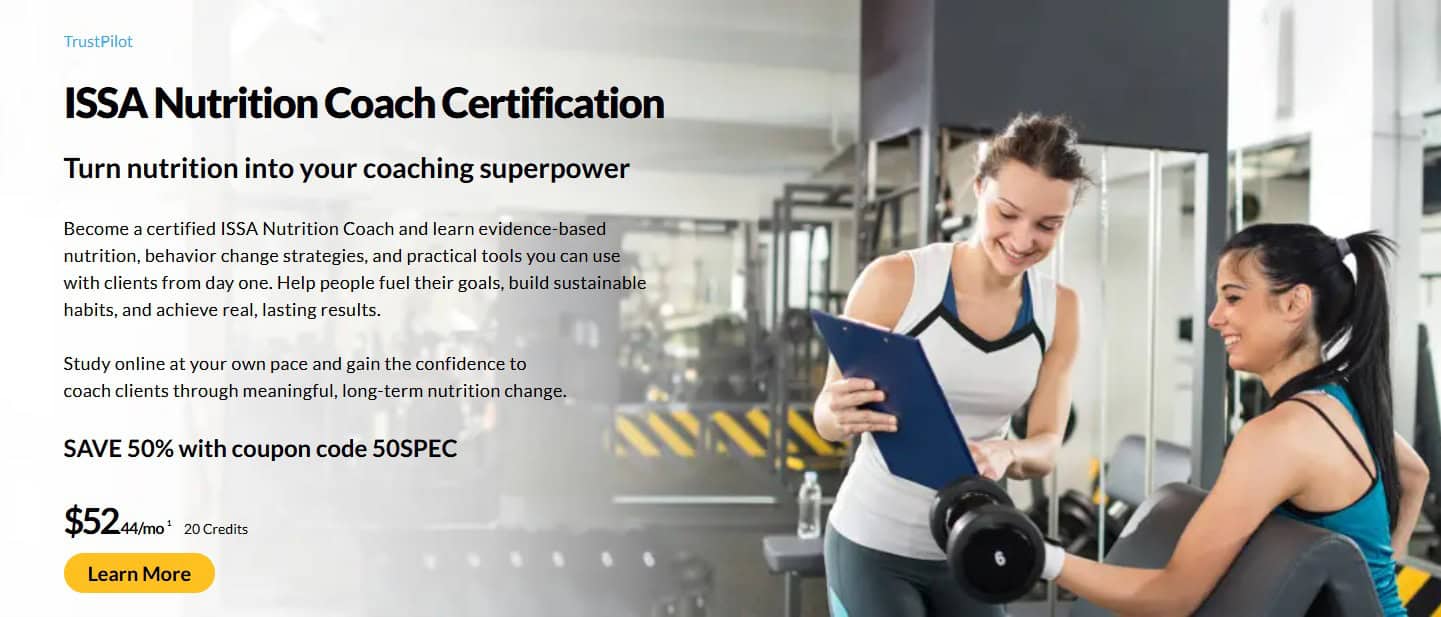
The International Sports Sciences Association’s (ISSA) Nutrition Coach Certification is the best entry point for new and experienced trainers looking to offer more than just exercise to their clients. It provides the most well-rounded single nutrition certification, without breaking the bank. They’ve been offering nutrition training since 1995, so you know they have experience and longevity in creating coursework that isn’t just based on trends.
ISSA’s program costs roughly $630 through their one-year monthly payment plan, or discounted if you purchase the entire course upfront. They’re committed to providing a quality education that fits within the realm of what most states allow for nutrition coaching, offering behavioral change education that works in states with strict regulations and personalized meal plan design for more lenient ones.
Curriculum
When I looked into ISSA’s actual curriculum, the first thing I loved was that a course outline was available before purchase. Many other programs gatekeep their content, so you don’t really know what you’re learning until you’ve already paid. With ISSA’s program, you can see the topics that will be addressed in the textbook and decide if it’s right for you.
The first half of the course dives into the science of nutrition, talking about metabolism, energy balance, and major and micronutrients. Once a student has that solid foundation, the second half of the course transitions to the coaching and practical application of nutrition coaching, discussing client assessment, business, supplements, and nutrition for special populations.
Program Strengths and Weaknesses
Their program didn’t push students into any one coaching style or method, but rather provided a buffet of options (pun intended) to choose from. This makes it an ideal program for the trainer who wants to fully customize their nutritional offerings, rather than follow a program’s specific meal plans and strategies.
If you already have an in-depth knowledge of either nutrition science or behavioral coaching and psychology, the program may not challenge you enough. The course does a great job of addressing both, but if you already know a lot about one (e.g., you have a minor in nutrition or the like), you may want to choose a course that focuses on teaching to your weaknesses.
Learning Format
The course is an online, move-at-your-own-pace style course that can be done on any device. There are textbook, audio, and video elements. It is definitely a more reading-heavy course, so if you learn well from books, this is a great option. If you’re not a book learner, you may want to look elsewhere. ISSA offers live help and Q&A sessions, which are considered by many to be the highlight of the course. The course concludes with an open-book, open-note test for a pretty low-stress testing experience.
Who It’s Best For
ISSA’s Nutrition Coach certification is best if you value:
- Science combined with practical application
- Premade client tools and business planning
- Live interaction with teachers and other students
2. Precision Nutrition Level 1 Nutrition Certification
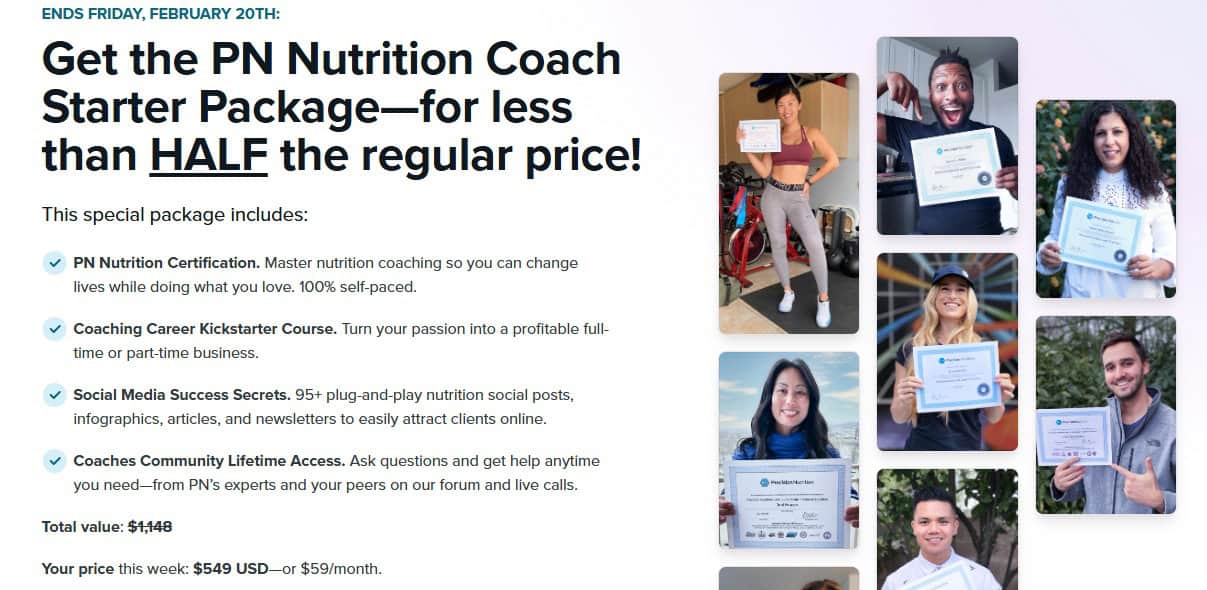
If you’re someone who likes a clear path and process for training clients, Precision Nutrition offers just that. Through their unique course, you’ll be taught to use their specific coaching system to help your clients build healthy nutritional habits. Priced just slightly higher than ISSA’s nutrition certification, you’re getting a great quality program for a relatively reasonable price.
This course adheres to Precision Nutrition’s 6-step coaching process, which offers simple steps to help clients improve their nutrition, while keeping you within your scope of practice. Their process helps you work within your scope of practice, though you should still check with your state to make sure you’re compliant with their requirements.
Curriculum
Precision’s course’s curriculum is unique. Rather than starting with the science of nutrition, they open with their approach to coaching. They introduce the program and some of the things that make Precision Nutrition and their coaching methods stand out. It helps students get in the mindset of a coach before they start learning, which lets them see the rest of the course through different eyes. If you’re not someone who wants to be immediately engaged with an organization’s methodology or just want the science, it may be a bit of a turn-off.
After moving through their approach, you’ll jump into the nutrition science part of the class, which is about a third of the program. It covers all of your standard nutrition education, along with a section on stress, recovery, and sleep, which is something we don’t always see in a nutrition course, despite it being an integral part of nutrition.
The last third of the course takes students through Precision Nutrition’s coaching process and how to train different “levels” of clients. Also included is a small section on business to help you structure your nutrition coaching offerings.
Program Strengths and Weaknesses
Precision Nutrition has by far the most unique coaching methodology of any nutrition certification I looked at. If you are someone who likes to have a concrete, proven process with everything laid out for you, this is a great option. I think it makes an especially attractive option for trainers who are new to coaching in general, because it gives them a structured framework to help them discover their unique coaching style.
If you are someone who is already developed as a coach and know the way you like to work, Precision Nutrition’s specific methods may feel a little intrusive. It provides a great education, but it doesn’t leave as much room for creativity in the way you work with your clients as other options.
Learning Format
The course has a combination of textbook, video, and case study learning. Their textbooks are available in physical and digital forms, which makes it nice for both types of learners. If you are relying on a digital textbook, note that it is not a PDF or ebook format, but rather an integrated part of their learning platform, which can be inconvenient.
Their testing process is cumulative, meaning that there is no single end-of-course test. Instead, you’ll have 20 10-question open-book tests (200 questions total) throughout the course. Out of those 200 questions, you must get 150 correct to pass. They also offer a proctored test, which, if you pass, can give you the option of receiving 3 credit hours at select US colleges.
Who It’s Best For
Precision Nutrition’s Level 1 Nutrition Certification is best if you value:
- Defined coaching processes and methods
- College credit at select institutions
- A certification well-known in gyms.
3. AFPA Certified Nutrition Coach Programs
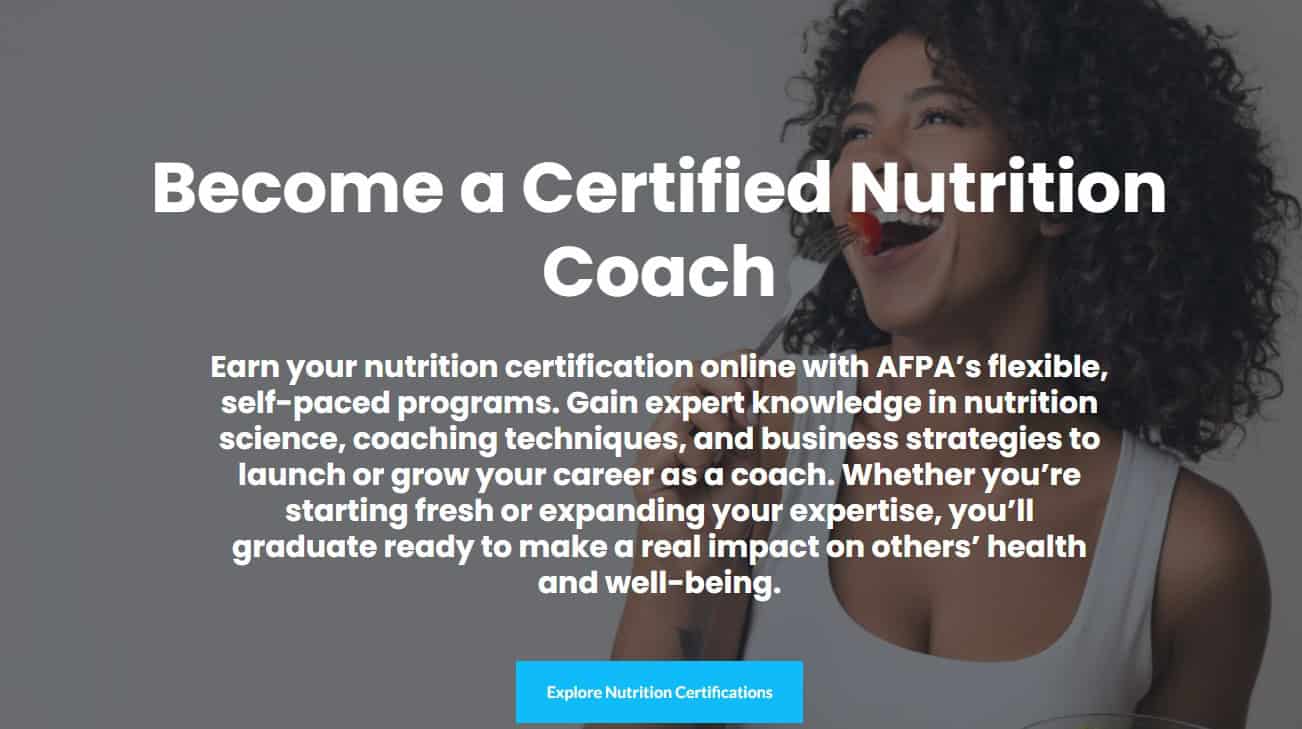
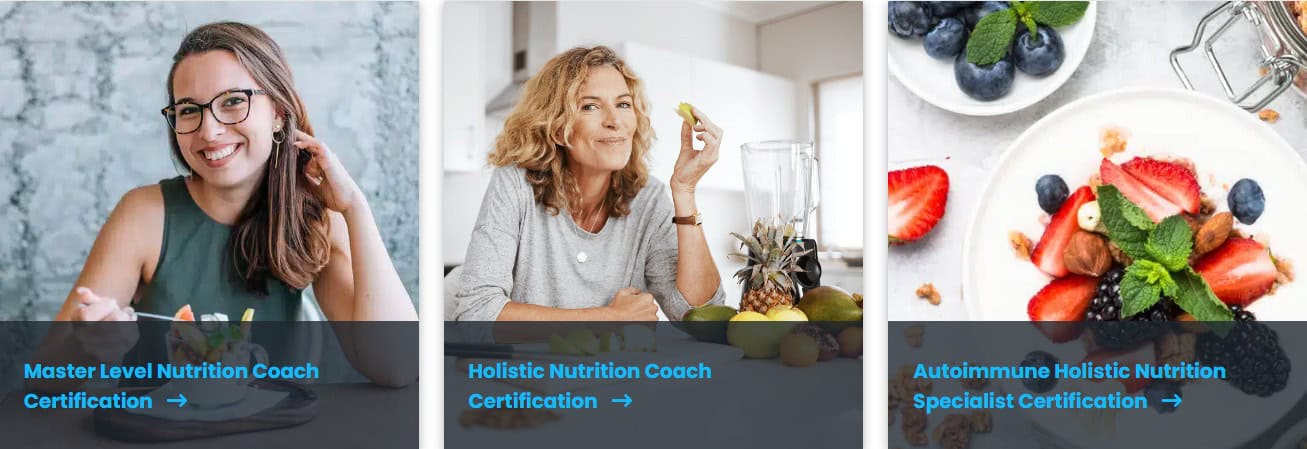
American Fitness Professionals and Associates (AFPA) is another company with a long legacy of creating quality programs for fitness pros. Their approach to nutrition certifications is ideal if you want to dive into a specific niche within the field. Where most other organizations offer one or two nutrition certifications, AFPA offers 8 unique nutrition certifications, including:
- Master Level Nutrition Coach
- Holistic Nutrition Coach
- Autoimmune Holistic Nutrition Specialist
- Plant-Based Nutrition Specialist
- Sports Nutrition Certification
- Holistic Health Coach (dual nutrition and health coaching program)
- Gut Health Nutrition Specialist
- Nutrition and Behavior Change
If you know what niche you want to go into, you’ll likely find it in one of these courses. If you’re not sure what direction you want to head or want to work with a larger variety of clients, consider a more overarching certification like the one from ISSA mentioned above.
Curriculum
The curriculum for these courses varies depending on which path you choose, but each has the core tenets of nutrition programming. They are like the coach’s coach and teach you ways to implement nutrition coaching with your individual clients. Their focus is on research-based nutritional science, with an emphasis on helping you and your clients distinguish between accurate nutrition advice and untrue information. This is something that I love, because it feels like they’re setting up their students for success in the future. Because nutrition is constantly evolving (and the internet is full of misinformation), it’s important to know what to look for and how to find truthful, effective nutrition advice.
Throughout all of AFPA’s nutrition certifications, you’ll see themes of behavior change and motivational interviewing to help get your clients from science to results. Also highlighted during their courses is cultural competence, or the awareness of and sensitivity toward food and diets of different cultures and socioeconomic circumstances. You’ll learn their Holistic Nutrition Framework, which is a model for working with clients to support their overall health.
Program Strengths and Weaknesses
For AFPA, their biggest weakness is also their biggest strength. Their programs have so much variety and diversity, which makes them stand out against general certifications. But it can also lead to decision paralysis for the student who isn’t sure of their niche.
If you’re someone who has spent a while in the fitness industry, you may already know your clients or who you want your potential clients to be, which makes the decision to go into a niche easier. If you’re someone just getting into fitness and/or nutrition, it might be a good idea to spend a while getting a sense of who you can and want to train before diving into a niche. Your niche may also depend on where you live. Again, some states may have limitations on how you can practice, and some areas may not support niches as well as others.
Learning Format
All of AFPA’s nutrition courses are completely online, textbook-free courses. Everything runs through their online platform, giving you access to all course content in a single place. This is nice if you get frazzled by too many resources, but it makes it more difficult to refer back to for periodic questions after completing the course. Courses are self-paced, making them great for working professionals. Each course has a final exam, which can be taken from home and is open-note.
Who It’s Best For
AFPA’s nutrition certifications are best if you value:
- Niche work and education
- Learning to distinguish truth and falsehoods in the nutrition world
- Coursework all in one resource
Choosing the Best Nutrition Certification for You
Each of these certifications represents the best in online nutrition education outside a university setting. They offer a diverse range of applications and learning styles to fit any trainer out there. For the trainers who want to learn it all and do it all, ISSA may be a great fit. They’ll give you a solid foundation to help your clients start seeing results. If you prefer a given-to-you process, Precision Nutrition offers its proven method of coaching clients to better nutrition. And for the trainers who know their niche, AFPA has a wide range of classes to help you dive deeper into the work and clients you love.
Start by deciding what kind of nutritional guidance you want to provide, then learn about what’s within your scope of practice and legally allowed where you live and coach. Once you know who and how you want to train, look at the other elements involved, like your learning style, extras like client forms and tools, and continuing education credits. All together, you’ll be armed with the information you need to make the next step for you and your clients.
Related Posts:






Sara has a B.S. in Exercise Science and is a 200-hr yoga teacher, mat Pilates Instructor, certified life coach, and certified personal trainer. She provides workshops, content, and consulting for individuals and businesses to foster growth and improve well-being. She has worked on the corporate level for international fitness companies, trained other fitness professionals across the U.S., and worked with numerous fitness start-ups and wellness businesses around the globe promoting whole-person wellness. Sara loves helping others live and move in a way that empowers and uplifts them. She encourages people to connect to their bodies and the world around them through fitness, nutrition, and mind-body work. When she’s not in the gym teaching, she’s probably outside somewhere, finding her soul up in the mountains or out in the desert.