
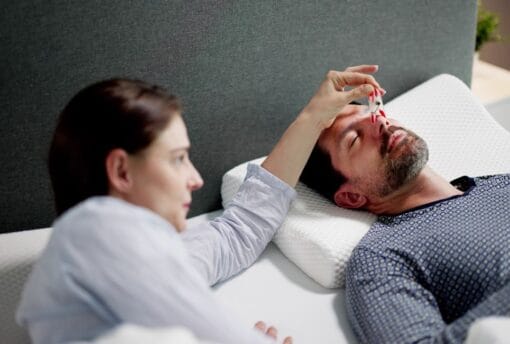
Have you ever woken up with your mouth taped shut? Maybe you were a kidnap victim or just spent the night at the wrong sleepover… well, you’re not alone. Mouth taping for snoring and obstructive sleep apnea (OSA) went viral for a reason. Not only is it cheap, but for some people, it actually works pretty well. But what if it doesn’t? What if, for us, it peels off in the night, and our partner still complains that our snoring is shaking the whole house awake?
As a chiropractor, I have spent many years building a practice where my mission is to treat and rehab the body in the most natural and non-invasive ways possible. In my office, I hear the same story almost weekly: a patient (or more often their spouse) walks in saying, “Doc, I snore like a freight train, I wake up exhausted, and my last doctor just told me that I needed a CPAP.”
For many reasons, these patients and their spouses hate the CPAP. Not because it doesn’t work, but because it’s loud, it’s bulky, and it’s just plain uncomfortable. What we have found is that the majority of snoring and mild-to-moderate cases of OSA never needed it in the first place. As a conservative clinician, my philosophy is simple: We find a solution that is the least invasive, not dangerous, and that actually corrects the problem instead of managing the symptom forever.
Before we talk about solutions, let’s discuss what’s actually happening when you (or your partner) sound like a freight train at night.
Topic Contents
What Is OSA?
Obstructive Sleep Apnea (OSA) is characterized by the collapsing of your airway. This can occur dozens, or even, hundreds of times every night while you sleep. The soft tissues inside your mouth and throat lose their tone and get sucked together to block your airway. Your brain freaks out, wakes you up just enough to gasp or snort, and you fall right back asleep, usually without remembering it. Each event lasts 10-60 seconds, oxygen levels drop, carbon dioxide levels elevate, and your rest gets hammered all night long. Do that 15-30 times an hour and you’ve got moderate-to-severe OSA. Do it 5–15 times, and you’re in more of the mild to moderate zone. Either way, the next day, you feel like you wrestled a bear and lost.
Snoring without apnea is, more or less, the same collapse, but the airway never gets fully blocked; it just vibrates the floppy tissues like a flag in the wind. You still have the noise that keeps everyone else awake, but your oxygen stays mostly okay, and the brain doesn’t have to hit the panic button.
Additional common causes that can complicate snoring or OSA:
- Mouth breathing
- Sickness, congestion, or deviated septum
- Weak or fat tongue muscles
- Excess weight
- Alcohol or sedatives
- Aging
Other than keeping the peace around the house, why do we care? OSA has been shown to increase risk for conditions like high blood pressure, diabetes, heart disease, and stroke. The good news? For the vast majority ofmild-to-moderate cases, the problem is mechanical and neuromuscular, and can be reversible without a lifetime of masks
So let’s walk through the real-world options I discuss with patients every week.
When Mouth Tape Makes Sense
Mouth Taping is everywhere right now. Seems like every social media platform and every influencer is using these right now. They come in all shapes, sizes, colors and brands– ZZZtape and SomniFix– just to name a couple. I often start here because it’s really inexpensive and teaches nasal breathing. If this solves the problem, why go on to something more expensive? First, I’ll suggest that the patient tape their lips for a week as a diagnostic tool. If their snoring drops dramatically and they feel better, great! But in my experience, only 20-25% of the cases experience partial relief. Tape forces the behavior of nasal breathing, but it doesn’t retrain the neuromuscular system. It won’t keep the tongue from collapsing. The tape is quite literally a band-aid fix.
My Picks For The Best Alternatives To Mouth Tape
Oral Devices (SnoreRx)

If the taping doesn’t work, we move on to oral devices like the Snore RX. These mandibular positioning devices work by mechanically pulling the lower jaw and tongue forward. They work really well for many people… until they don’t. After a while, some of my patients suffer TMJ dysfunction and bite changes. This can be painful and limiting in its own way. I still recommend this device from time to time, but usually only as a temporary optionwhile we work toward a better solution.
Nasal devices (Nanocap)
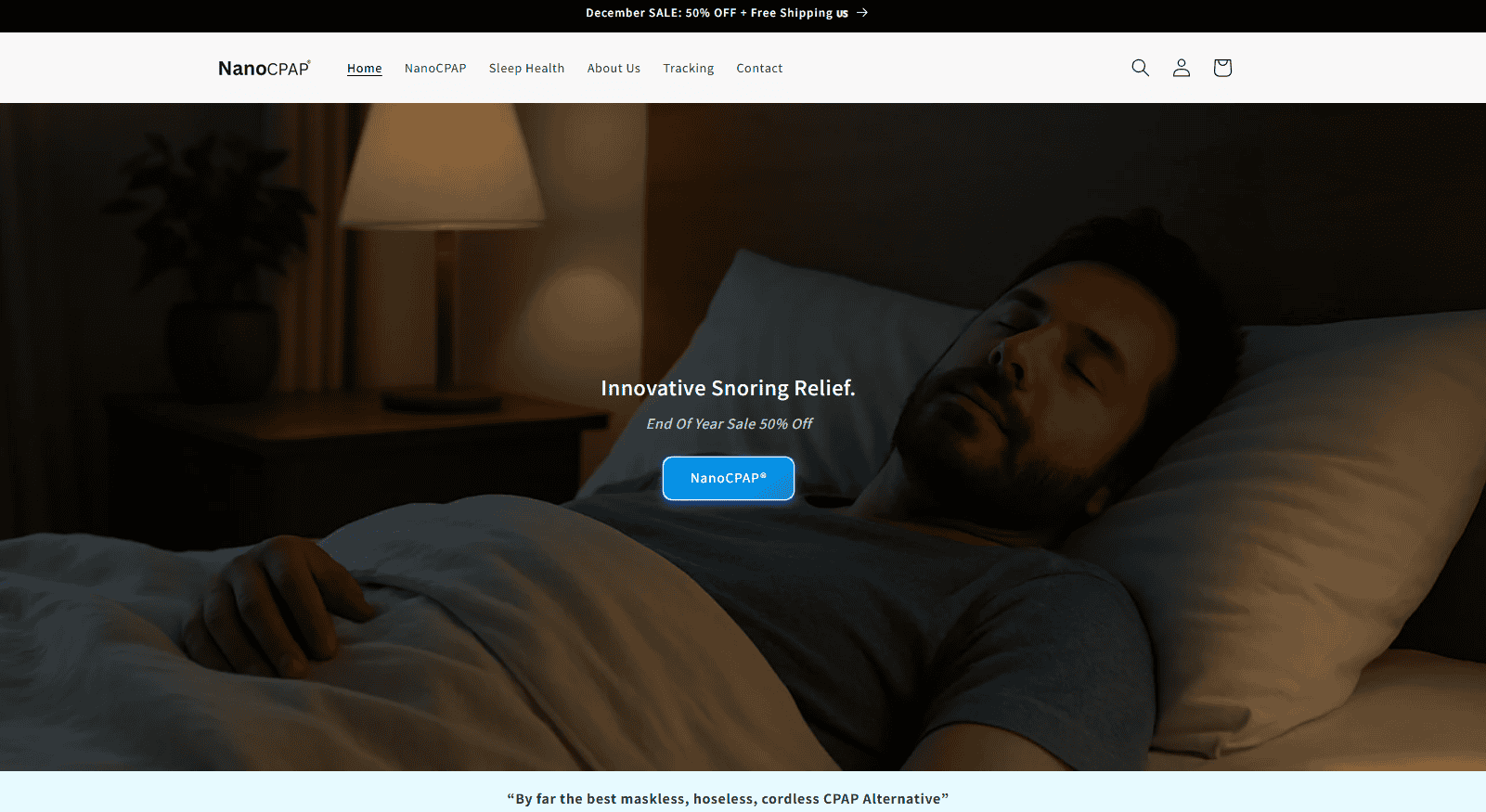
These are like little air jet packs you strap to your nose, like the CPAP, but much smaller and compact. Pros: not nearly as cumbersome, less expensive, much quieter. Cons: You still have a foreign device strapped to your head that only works while it is left in place. Still, this doesn’t really address the cause. The moment the tongue or soft palate relaxes and drops back, the airway is closed off, and the tiny airflow these devices do produce can’t overcome the obstruction. For these reasons, I rarely recommend these as a viable option.
Neuromuscular Electrical Stimulation Device (eXciteOSA)
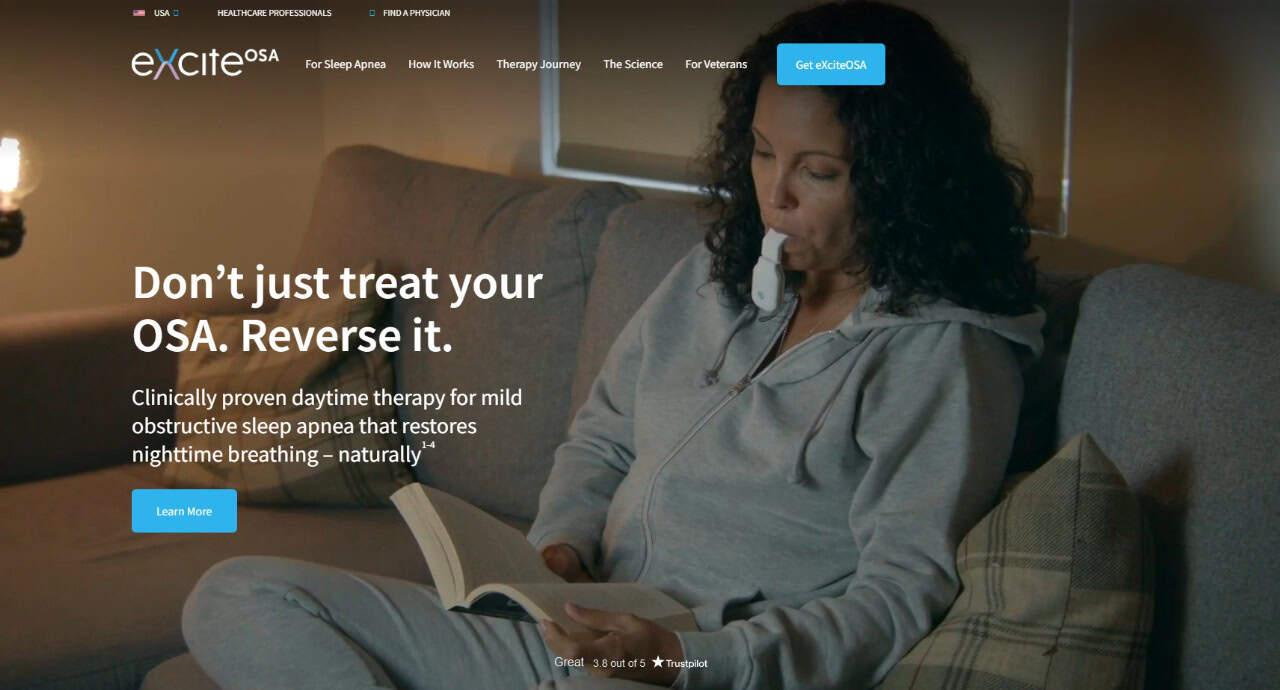
This is the tool I now go to first in almost every snoring or mild-to-moderate OSA case, and the one I trust for my Dad to use to manage his OSA.
Here’s why it aligns perfectly with everything I believe in:
- It’s completely non-invasive
- It addresses the actual root cause of weak glossopharyngeal muscles. Think of it in the same way that people strengthen weak core muscles after a back injury
- It requires no bulky nighttime hardware or harnesses
- It’s evidence-based with multiple randomized, controlled trials with objective, reproducible outcomes
In my clinic, the results have been pretty cool. Patients report more restful nights, their partners stop escaping to the guest room, and daytime energy levels improve. All this is because we’re actually addressing the problem. And because we are strengthening the airway, the same way we strengthen the deep lumbosacral stabilizers after a disc injury, the results tend to last.
The treatment protocol is simple: 20 minutes a day for 6 weeks while you’re awake (most patients find a time to do it while they do daily tasks like catching up on emails or watching TV). After this, then 2–3 sessions a week for maintenance. The sensation is a gentle, rhythmic contraction. It should NOT be painful; if it is, you’re doing it wrong.
This is how I explain it in the clinic: Think of your tongue like the deep neck flexors that keep your head from falling forward all day. When those neck muscles get weak, you can get a forward-head posture and subsequenttension and pain. When the tongue muscles get weak or the tissue around the airway gets heavy, you can get airway collapse and snoring. eXciteOSA is essentially neuromuscular re-education; the same principle we’veused successfully for decades in spinal rehabilitation, now applied to the upper airway.
The last resort – Upper Airway Stimulation (Inspire)

When all else fails, this procedure is a legitimate lifesaver for severe, CPAP-intolerant patients.
This device works as an implanted stimulator that causes a contraction in the muscles that protrude the tongue. This device syncs with your breathing, so as you breathe in and out, your body gets gentle impulses that lift the tongue and improve airway opening. As a conservative care doctor, I’m thankful this exists, but I also know it’s major surgery with a hefty price tag (even with insurance). In my practice, we reserve it for patients who don’twant to put the work in or who are true treatment failures.
My current conservative flow:
1. Week 1–2 diagnostic mouth taping
2. If the patient prefers, we do a trial with the oral mandibular device.
3. When the oral device failed or was found to be painful, start eXciteOSA therapy for 6 weeks of consistent treatment.
4. A new sleep test is warranted at week 8. If results are better and seem to hold, then we’re done! No further intervention needed, just maintenance.
5. However, if problems remain severe, we refer for CPAP or ENT evaluation (potentially an Inspire consultation).
Final Thoughts
As a healthcare provider, my job isn’t to keep you coming back forever or to sell you the most expensive option. My job is to educate you on all the options and help you to make the best decision for you that will get your airway functioning so you can sleep deeply, wake refreshed, and get back to doing the things you love to do.
The right treatment will ultimately depend on your needs and your comfort, but eXciteOSA is the first therapy I’ve found that is conservative, predictable, and lasting and actually helps me find success for my OSA patients. I like that it’s a real solution that addresses the root cause, not just a cover-up band-aid fix. Because your spine isn’t the only thing that deserves to be strong and stable; your airway does too.
Related Posts:



Trevor is a licensed chiropractor with a Master’s degree in Sports Medicine and hands-on experience in rehabilitation and physical therapy. He works daily with patients to restore movement, reduce pain, and improve performance. His real-world experience in injury recovery, mobility training, and evidence-based care allows him to translate complex musculoskeletal and sports medicine concepts into clear, practical guidance so people can move better, recover smarter, and stay active for the long term.