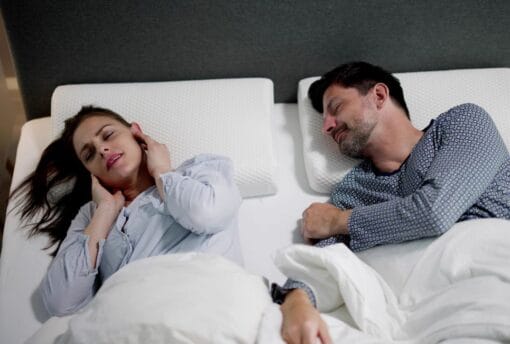
Since you’re reading this, chances are you, or someone you sleep in close proximity to, are tired of the nightly freight train barreling through the house. Maybe you’ve already tried mouth tape, a custom mouth insert, or you’re dreading bedtime, where you have to strap that elephant trunk of a CPAP machine to your face. I get it. I hear this same story in my office every single week.
Maybe you didn’t know, but people seek chiropractic care for all sorts of things, including breathing problems. My patients who have been diagnosed with Obstructive Sleep Apnea (OSA) or who just complain about fatigue from restless nights associated with snoring often ask if I have any recommendations or treatment options for them.
The good news? For the vast majority of people with simple snoring or OSA, the problem is mechanical and neuromuscular. That means we can often fix it or improve it without masks, machines, or surgery. The even better news? The key to rehab and relief is already in your mouth! Your tongue and the muscles that hold your airway open while you sleep can be excised and trained.
As a Chiropractor, I am a huge advocate for minimally invasive ways to solve dysfunctions throughout the body. And the problems that OSA and snoring cause are no different. Let’s break down the way I help patients approach this problem
Topic Contents
OSA? What’s actually happening when you snore (or stop breathing)
When you fall asleep, your body goes through phases or cycles. In the N2 phase, every muscle in your body starts to go into a deep state of relaxation. This is normal, but where the problem starts is when the muscles in and around your throat, especially your tongue and soft palate, relax too much or don’t have the muscle tone to stay in their place. Gravity takes over, and the tongue falls backward into the airway space, and before you know it, you’re inhaling all those loosey-goosey tissues.
Simple snoring and OSA are not the same, however. There are important distinctions. Snoring occurs when the tissues flap and vibrate like a flag in the wind. This can be loud, annoying, and may wake you or those around you up during the night, but blood-oxygen levels usually remain okay. Obstructive Sleep Apnea is a different story. In OSA, the airway actually closes all the way off for 10 or more seconds at a time. When this happens, your brain goes into red-alert mode, and you are forced to wake up. Sometimes so subtly, you won’t remember it, but your body does. This can occur as many as 30 times an hour.
Exhausting.
The hopeful part? In most mild to moderate cases, the tissues are just weak or out of shape, not permanently damaged. Think of it like the deep core muscles that stabilize your lower back. When they get weak, you are predisposed to back pain and injuries during normal daily activities. Similarly, when the deep airway muscles get weak, you end up with snoring and apnea. The treatment then? Well, it’s the same approach – rehabilitation and strength training.
The Viral Solutions
Before we talk about exercises, I’ll quickly run down the “solutions” most people try first. Like the ones you see all over TikTok and other social platforms.
Mouth Taping (ZZZtape, SomniFix, etc.)

Mouth taping forces the mouth to stay closed and teaches nasal breathing. This is the least expensive option, so you can try it out without breaking the bank if it doesn’t work for you. Try for a week as a diagnostic tool. If snoring drops dramatically and you feel better, great!
Oral Devices (SnoreRx)

Mandibular positioning devices work by mechanically pulling the lower jaw and tongue forward. It works really well for many people… until it doesn’t. Some patients suffer TMJ dysfunction and bite changes, which can be painful
Nasal devices (Nanocap)

Little air jet packs you strap to your nose. Same idea as the CPAP, but much smaller and compact.
- Pros: not nearly as cumbersome, less expensive, much quieter.
- Cons: You still have a foreign device strapped to your head that only works while it is left in place.
All of these are passive treatments. Meaning they only work while you’re using them. Remove the device, and the underlying problem remains.
The Active Approach: 7 Exercises That Actually Strengthen Around The Airway
Did you know that there are entire professions and certifications that specialize in training the mouth and airway to work together? It’s called Orofacial Myofunctional Therapy (OMT) and is most often provided by Occupational Therapists (OTs) or Speech-Language Pathologists. If your symptoms are severe or you would like direct, hands-on assistance, you may want to seek one of these to help.
Here are 7 exercises I give patients. I recommend doing them daily for 6-12 weeks. When done regularly, most people notice a real difference.
- Tongue Push-Ups
- Press your entire tongue firmly against the roof of your mouth for 5 seconds, relax, repeat 10–20 times. This is the #1 move for strengthening the genioglossus muscle that keeps your tongue forward all night.
- Tongue Slides (“Click the Tongue”)
- Suction the tongue to the roof of the mouth, then slide the tip backward as far as possible while keeping suction. Hold 3–5 seconds, repeat 10–15 times.
- Swallowing with Tongue Up
- Keep your tongue pressed firmly to the roof of the mouth while swallowing saliva (no water). Do 10–15 swallows. This coordinates the entire upper airway.
- Tongue Clicks
- Make loud clicking sounds by suctioning and releasing your tongue against the roof of the mouth. Like you did when you were a kid. Click steadily for 15 seconds, rest, repeat 10 rounds.
- Uvula Lifts
- While looking in the mirror, mouth open wide, contract the back of your throat to make your uvula bounce up and down. Go for 30 seconds straight. This directly targets throat muscle laxity.
- Tongue 4-way
- Nose Touch
- Stick your tongue out straight and try to touch the tip of your nose. Hold 10 seconds, repeat 10 times.
- Chin Lick
- Stick your tongue out and try to lick the bottom of your chin. Hold 10 seconds, repeat 10 times.
- Left Tongue Reach
- Stretch your tongue as far left as possible. Hold 10 seconds, repeat 10 times.
- Right Tongue Reach
- Same as above, but to the right side. Hold 10 seconds, repeat 10 times.
- Spoon Push
- Push the tip of your tongue firmly against a spoon held horizontally in front of your lips. Keep the tongue straight—no curling down. Hold 10 seconds, repeat 10 times. This is resistance training for the tongue.
7 exercises. 10–15 minutes a day. My favorite time to suggest you knock them out is after brushing your teeth, while driving, or while watching your favorite show. Set an alarm on your phone to go off at the same time every day and go get ‘em!
No matter the severity of the condition or the setting, the recipe is the same as any other exercise: The effort you put in determines the reward you get out. In my clinic, I see the same pattern. So many of my patients start excited and motivated, only to find out at the follow-up appointment that they didn’t stick with it long enough to get lasting results.
The solution: eXciteOSA
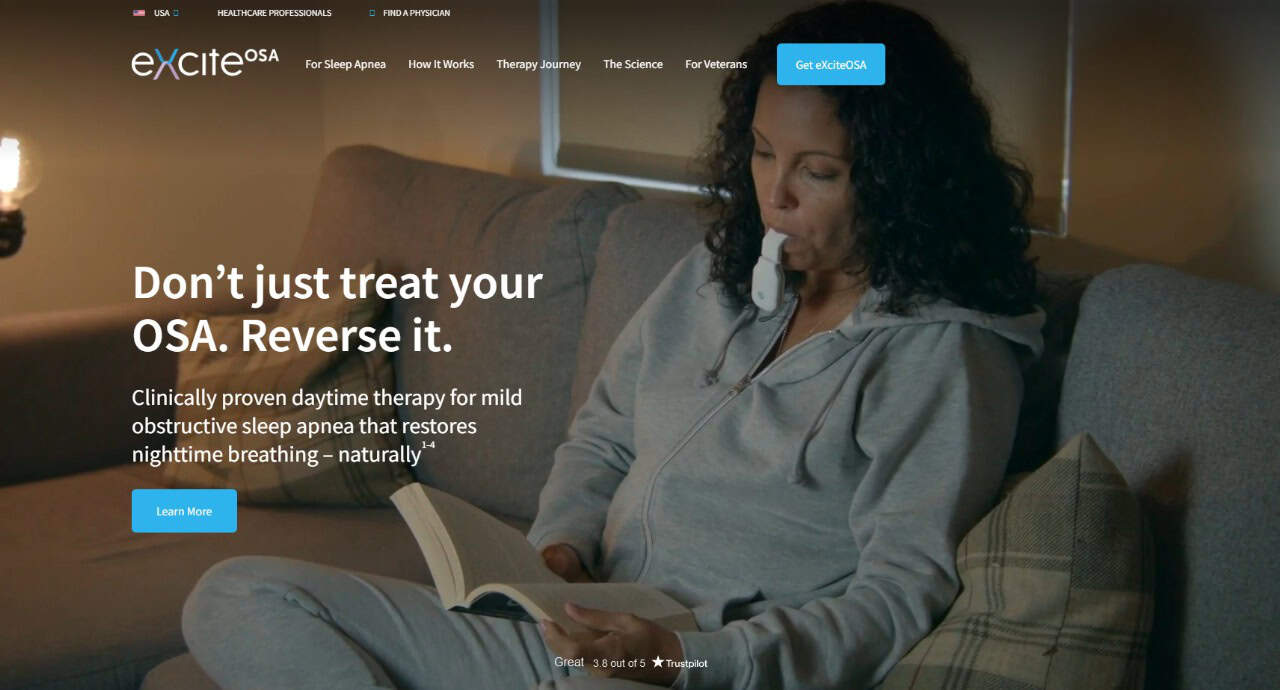
That’s where eXciteOSA comes in. eXciteOSA is equivalent to having a personal trainer deliver the perfect strengthening contractions to the exact tongue and soft-palate muscles you need in just 20 minutes.
Here are some of the highlights:
- FDA-cleared and clinically tested neuromuscular stimulation therapy
- Naturally achieve the same muscle-strengthening effect using daytime neuromuscular stimulation—often with faster, more consistent results than months of exercises alone.
- Clinical studies show:
- 79% average reduction in snoring time
- 50% average drop in AHI (number of times breathing stops each hour) for mild-to-moderate OSA
- Benefits that last long after the initial 6-week program
Protocol: 20 minutes a day for 6 weeks while you’re awake – most of my patients find a time to do it while performing daily tasks like catching up on emails, doing the dishes or watching TV. After this, it should only take 2–3 sessions a week for maintenance. The sensation is a gentle, rhythmic contraction. It should NOT be painful; if it is, you’re doing it wrong.
My Suggested Treatment Flow
- See a sleep specialist or order an at-home sleep test to get a good baseline of where you are at currently.
- Weeks 1 & 2: start diagnostic mouth taping and begin the 7 exercises mentioned above
- If you don’t notice any improvement, consider picking up eXciteOSA
- After trying these, do a follow-up sleep study sometime between weeks 8 -10. The vast majority of mild-to-moderate cases are fixed or dramatically better.
- Unfortunately, some cases remain severe; for these, we are often forced to refer for a CPAP prescription or ENT evaluation. If this is you, don’t worry. Not all hope is lost. Your doctor may have some other great options for you.
So What’s Right for You?
If you’re someone who is self-motivated and has the discipline, start the 7 exercises today.
Or do you want the benefits of an improved airway by training without the daily hassle? eXciteOSA is the simplest, most effective active treatment that is proven to get you lasting results. Either way, you’re building a strong, stable airway that stays open naturally. Finally, you can sleep well, wake up refreshed, maintain good health and keep your partner happy.
Your tongue is the best oral device you’ll ever own. The only questions are whether you want to ignore it, train it the hard way, or let a little device do the heavy lifting for you.
Related Posts: